


Page 46 - A Mind For Numbers: How to Excel at Math and Science
P. 46
that you, too, may be able to develop ways to quickly toggle between the
               focused and diffuse modes as you develop your expertise in a subject.
                    Incidentally, Carlsen probably also knew his bouncing from his chair would
               distract Kasparov. Even slight distractions at that level of play can be
               disconcerting—a reminder for you that deep focused attention is an important
               resource that you don’t want to get pulled out of. (Unless, that is, it’s time to
               purposefully take a step back and let the diffuse mode take over.)

                    Figuring out a difficult problem or learning a new concept almost
               always requires one or more periods when you aren’t consciously working
               on the problem. Each interlude in which you are not directly focused on the
               problem allows your diffuse mode to look at it in a fresh way. When you turn
               your focused attention back to the problem, you consolidate new ideas and
               patterns that the diffuse mode has delivered.


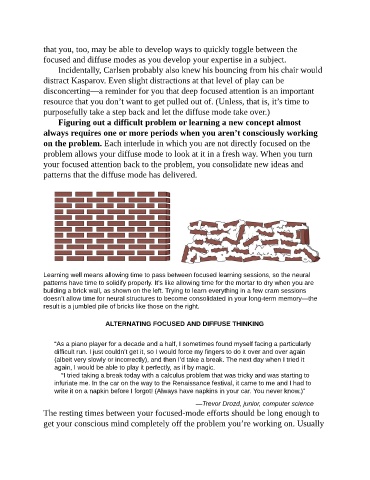
               Learning well means allowing time to pass between focused learning sessions, so the neural
               patterns have time to solidify properly. It’s like allowing time for the mortar to dry when you are
               building a brick wall, as shown on the left. Trying to learn everything in a few cram sessions
               doesn’t allow time for neural structures to become consolidated in your long-term memory—the
               result is a jumbled pile of bricks like those on the right.

                                    ALTERNATING FOCUSED AND DIFFUSE THINKING


                   “As a piano player for a decade and a half, I sometimes found myself facing a particularly
                   difficult run. I just couldn’t get it, so I would force my fingers to do it over and over again
                   (albeit very slowly or incorrectly), and then I’d take a break. The next day when I tried it
                   again, I would be able to play it perfectly, as if by magic.
                     “I tried taking a break today with a calculus problem that was tricky and was starting to
                   infuriate me. In the car on the way to the Renaissance festival, it came to me and I had to
                   write it on a napkin before I forgot! (Always have napkins in your car. You never know.)”

                                                                  —Trevor Drozd, junior, computer science
               The resting times between your focused-mode efforts should be long enough to

               get your conscious mind completely off the problem you’re working on. Usually

