


Page 69 - A Mind For Numbers: How to Excel at Math and Science
P. 69
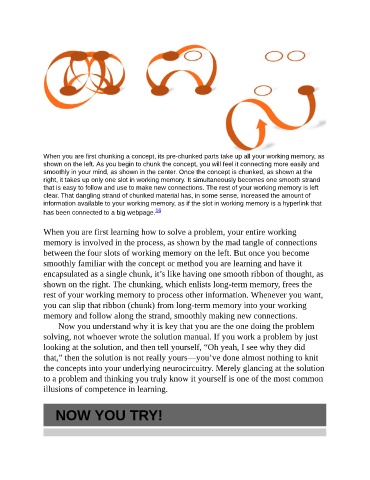
When you are first chunking a concept, its pre-chunked parts take up all your working memory, as
               shown on the left. As you begin to chunk the concept, you will feel it connecting more easily and
               smoothly in your mind, as shown in the center. Once the concept is chunked, as shown at the
               right, it takes up only one slot in working memory. It simultaneously becomes one smooth strand
               that is easy to follow and use to make new connections. The rest of your working memory is left
               clear. That dangling strand of chunked material has, in some sense, increased the amount of
               information available to your working memory, as if the slot in working memory is a hyperlink that
               has been connected to a big webpage. 16


               When you are first learning how to solve a problem, your entire working
               memory is involved in the process, as shown by the mad tangle of connections

               between the four slots of working memory on the left. But once you become
               smoothly familiar with the concept or method you are learning and have it
               encapsulated as a single chunk, it’s like having one smooth ribbon of thought, as
               shown on the right. The chunking, which enlists long-term memory, frees the
               rest of your working memory to process other information. Whenever you want,
               you can slip that ribbon (chunk) from long-term memory into your working
               memory and follow along the strand, smoothly making new connections.

                    Now you understand why it is key that you are the one doing the problem
               solving, not whoever wrote the solution manual. If you work a problem by just
               looking at the solution, and then tell yourself, “Oh yeah, I see why they did
               that,” then the solution is not really yours—you’ve done almost nothing to knit
               the concepts into your underlying neurocircuitry. Merely glancing at the solution
               to a problem and thinking you truly know it yourself is one of the most common

               illusions of competence in learning.


                   NOW YOU TRY!

