


Page 76 - A Mind For Numbers: How to Excel at Math and Science
P. 76
there to speak to you, telling you what you need to do next. In that sense,
               problem solving in math and science is like dance. In dance, you can feel your
               body hinting at the next move.
                    Different types of problems have different review time frames that are
                                                                    34
               specific to your own learning speed and style.  And of course, you have other
               obligations in your life besides learning one particular topic. You have to
               prioritize how much you’re able to do, also keeping in mind that you must

               schedule some time off to keep your diffuse mode in play. How much
               internalizing can you do at a stretch? It depends—everyone is different. But,
               here’s the real beauty of internalizing problem solutions in math and science.
               The more you do it, the easier it becomes, and the more useful it is.


                                           ORGANIZE, CHUNK—AND SUCCEED


                   “The first thing I always do with students who are struggling is ask to see how they are
                   organizing their notes from class and reading. We often spend most of the first meeting
                   going over ways they can organize or chunk their information rather than with my
                   explaining concepts. I have them come back the next week with their material already
                   organized, and they are amazed at how much more they retain.”

                              —Jason Dechant, Ph.D., Course Director, Health Promotion and Development,
                                                                School of Nursing, University of Pittsburgh


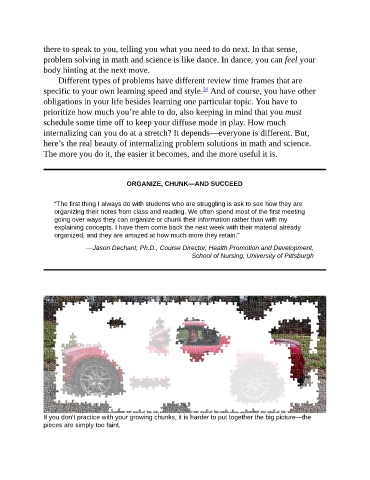
               If you don’t practice with your growing chunks, it is harder to put together the big picture—the
               pieces are simply too faint.

