


Page 87 - A Mind For Numbers: How to Excel at Math and Science
P. 87
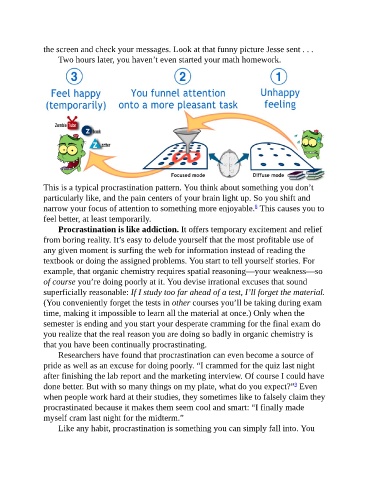
the screen and check your messages. Look at that funny picture Jesse sent . . .
                    Two hours later, you haven’t even started your math homework.


               This is a typical procrastination pattern. You think about something you don’t
               particularly like, and the pain centers of your brain light up. So you shift and
                                                                                     8
               narrow your focus of attention to something more enjoyable.  This causes you to
               feel better, at least temporarily.

                    Procrastination is like addiction. It offers temporary excitement and relief
               from boring reality. It’s easy to delude yourself that the most profitable use of
               any given moment is surfing the web for information instead of reading the
               textbook or doing the assigned problems. You start to tell yourself stories. For
               example, that organic chemistry requires spatial reasoning—your weakness—so
               of course you’re doing poorly at it. You devise irrational excuses that sound

               superficially reasonable: If I study too far ahead of a test, I’ll forget the material.
               (You conveniently forget the tests in other courses you’ll be taking during exam
               time, making it impossible to learn all the material at once.) Only when the
               semester is ending and you start your desperate cramming for the final exam do
               you realize that the real reason you are doing so badly in organic chemistry is
               that you have been continually procrastinating.
                    Researchers have found that procrastination can even become a source of

               pride as well as an excuse for doing poorly. “I crammed for the quiz last night
               after finishing the lab report and the marketing interview. Of course I could have
                                                                                                  9
               done better. But with so many things on my plate, what do you expect?”  Even
               when people work hard at their studies, they sometimes like to falsely claim they
               procrastinated because it makes them seem cool and smart: “I finally made

               myself cram last night for the midterm.”
                    Like any habit, procrastination is something you can simply fall into. You

