


Page 174 - Physics Form 5 KSSM_Neat
P. 174
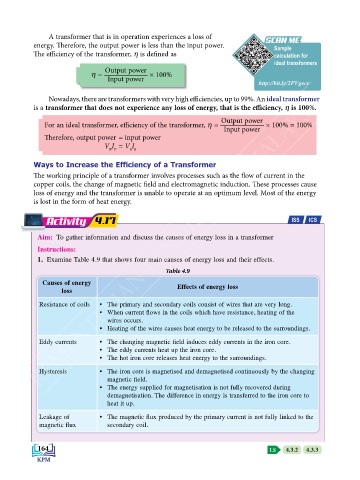
A transformer that is in operation experiences a loss of
                                                                                 SCAN ME
           energy. Therefore, the output power is less than the input power.     SCAN ME
                                                                                   Sample
           The efficiency of the transformer, h is defined as                      calculation for
                                                                                   ideal transformers
                                 Output power
                            h =               × 100%
                                 Input power
                                                                               http://bit.ly/2FVgecr
            KEMENTERIAN PENDIDIKAN MALAYSIA
                Nowadays, there are transformers with very high efficiencies, up to 99%. An ideal transformer
           is a transformer that does not experience any loss of energy, that is the efficiency, h is 100%.

                                                                   Output power
              For an ideal transformer, efficiency of the transformer, h =       × 100% = 100%
                                                                    Input power
              Therefore, output power = input power
                                V I  = V I
                                  P P
                                        S S
           Ways to Increase the Efficiency of a Transformer
           The working principle of a transformer involves processes such as the flow of current in the
           copper coils, the change of magnetic field and electromagnetic induction. These processes cause
           loss of energy and the transformer is unable to operate at an optimum level. Most of the energy
           is lost in the form of heat energy.

               Activity 4.17                                                             ISS  ICS


            Aim:  To gather information and discuss the causes of energy loss in a transformer
            Instructions:
            1.  Examine Table 4.9 that shows four main causes of energy loss and their effects.
                                                   Table 4.9
              Causes of energy
                                                      Effects of energy loss
                    loss
             Resistance of coils  •  The primary and secondary coils consist of wires that are very long.
                               •  When current flows in the coils which have resistance, heating of the
                                 wires occurs.
                               •  Heating of the wires causes heat energy to be released to the surroundings.

             Eddy currents     •  The changing magnetic field induces eddy currents in the iron core.
                               •  The eddy currents heat up the iron core.
                               •  The hot iron core releases heat energy to the surroundings.

             Hysteresis        •  The iron core is magnetised and demagnetised continuously by the changing
                                 magnetic field.
                               •  The energy supplied for magnetisation is not fully recovered during
                                 demagnetisation. The difference in energy is transferred to the iron core to
                                 heat it up.

             Leakage of        •  The magnetic flux produced by the primary current is not fully linked to the
             magnetic flux       secondary coil.


            164                                                                   LS     4.3.2     4.3.3

