


Page 230 - Physics Form 5 KSSM_Neat
P. 230
4.  During the formation of rocks, radioisotope uranium-238 is trapped. The decay rate of
                uranium-238 is low and the end result of the decay series is lead-206. Table 1 shows the
                composition of samples of rock A and rock B.
                                                   Table 1

                                                         Sample A         Sample B
            KEMENTERIAN PENDIDIKAN MALAYSIA
                       Ratio of uranium-238 to             5 : 1            7 : 1
                       lead-206

                (a)  Between the samples of rock A and rock B, which one is older? Justify your answer.
                (b) The composition of the lead nucleus is unlikely to be greater than the uranium nucleus
                    in the rocks sample. Explain your answer.


              5.  Carbon-14 has a half-life of 5 730 years.
                (a)  What is the fraction of undecayed carbon in a fossil sample at the end of
                    1.719 × 10  years?
                             4
                (b) Based on your answer to 5(a), sketch a graph of the decay curve for carbon-14 in the
                    fossil sample.


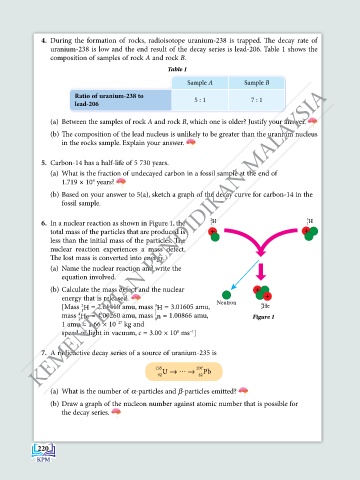
              6.  In a nuclear reaction as shown in Figure 1, the   2 1 H                    3 1 H
                total mass of the particles that are produced is   +                        +
                less than the initial mass of the particles. The
                nuclear reaction experiences a mass  defect.
                The lost mass is converted into energy.
                (a)  Name the nuclear reaction and write the
                    equation involved.

                (b) Calculate the mass defect and the nuclear                 +
                    energy that is released.                                     +
                                                3
                    [Mass  H = 2.01410 amu, mass  H = 3.01605 amu,   Neutron   4 2 He
                         2
                                               1
                         1
                                               1
                        4
                    mass  He = 4.00260 amu, mass  n = 1.00866 amu,           Figure 1
                                               0
                         2
                    1 amu = 1.66 × 10  kg and
                                    –27
                    speed of light in vacuum, c = 3.00 × 10  ms ]
                                                          –1
                                                      8
              7.  A radioactive decay series of a source of uranium-235 is
                                                235   U ˜  …  ˜  207   Pb
                                                92           82
                (a)  What is the number of a-particles and b-particles emitted?
                (b) Draw a graph of the nucleon number against atomic number that is possible for
                    the decay series.


            220

