


Page 118 - test1
P. 118
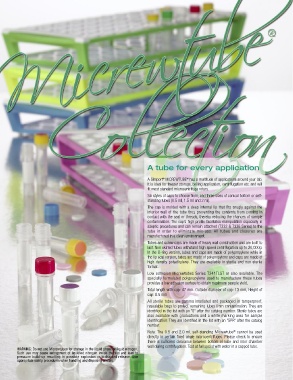
A tube for every application

                                                               A Simport MICREWTUBE has a multitude of applications around your lab.
                                                                               ®
                                                                     ®
                                                               It is ideal for freezer storage, boiling application, centrifugation etc. and will
                                                               fit most standard microcentrifuge rotors.
                                                               Six styles of caps to choose from, and three sizes of conical bottom or self-
                                                               standing tubes (0.5 ml, 1.5 ml and 2 ml).
                                                               The cap is molded with a deep internal lip that fits snugly against the
                                                               interior wall of the tube thus preventing the contents from coming in
                                                               contact with the seal or threads, thereby reducing the chances of sample
                                                               contamination. The cap’s high profile facilitates manipulation especially in
                                                               aseptic procedures and can remain attached (T332 & T336 Series) to the
                                                               tube in order to eliminate mix-ups. All tubes and closures are
                                                               manufactured in a clean environment.
                                                               Tubes and screw caps are made of heavy wall construction and are built to
                                                               last. Non skirted tubes withstand high speed centrifugation up to 20,000g.
                                                               In the O-ring version, tubes and caps are made of polypropylene while in
                                                               the lip seal version, tubes are made of polypropylene and caps are made of
                                                               high density polyethylene. They are available in sterile and non sterile
                                                               format.
                                                               Low adhesion Micrewtubes Series T341TLST ar also available. The
                                                               specially formulated polypropylene used to manufacture these tubes
                                                               provides a low adhesion surface to obtain maximum sample yield.
                                                               Total length with cap: 47 mm. Outside diameter of cap: 13 mm, Height of
                                                               cap: 8.5 mm
                                                               All sterile tubes are gamma irradiated and packaged in tamperproof,
                                                               resealable bags to protect remaining tubes from contamination. They are
                                                               identified in the list with an “S” after the catalog number. Sterile tubes are
                                                               also available with graduations and a white marking area for sample
                                                               identification. They are identified in the list with an “SPR” after the catalog
                                                               number.
                                                                                                   ®
                                                               Note: The 0.5 and 2.0 ml. self-standing Micrewtube cannot be used
                                                               directly in certain fixed angle microcentrifuges. Please check to ensure
                                                               there is sufficient clearance between bottom of tube and rotor chamber
                                                               wall during centrifugation. Test at full speed with water in a capped tube.
        WARNING: Do not use Micrewtubes for storage in the liquid phase of liquid nitrogen.
        Such use may cause entrapment of liquefied nitrogen inside the vial and lead to
        pressure build-up resulting in possible explosion or biohazard release. Use
        appropriate safety procedures when handling and disposing of vials.

