


Page 5 - 00002 Considerations for the design of exergames
P. 5
2005] present a modified version of flow, specialised to the video  We now examine the other dimension, the effectiveness of the ex-
            game domain, called “gameflow”. The components of this model  ergame in providing a valid exercise.
            are:
                                                                 5.2 Effectiveness
             1. Concentration - games should require concentration, and the
                player should be able to concentrate on the game.
                                                                 In order to maximise the exercise benefits of the exergame, the in-
             2. Challenge - games should be sufficiently challenging and  tensity and type of exercise needs to be considered. Target heart
                match the player’s level of skill.               rate plays a role, but it is important to realize that as players’ fitness
                                                                 levels improve, the physical intensity level required to reach their
             3. Player skills - games must support player skill development  target heart rate will increase.
                and mastery.
                                                                 This concept has overtones of the skill versus challenge balance in
             4. Control - players should feel a sense of control over their ac-  flow theory. Physical fitness corresponds to the body’s ‘skill’ in
                tions in the game.
                                                                 being able to cope with the exercise, and exercise intensity level
             5. Clear goals - games should provide the player with clear goals  corresponds to ‘challenge’ of the exercise on the body. Unlike flow
                at appropriate times.                            though, which can only be measured through several subjective cri-
                                                                 teria, the fitness/intensity balance has an absolute measure in the
             6. Feedback - players must receive appropriate feedback at ap-  form of heart rate.
                propriate times.
                                                                 From the previous review of literature, we have seen several studies
             7. Immersion - players should experience deep but effortless in-  that considered existing games in order to evaluate them as legit-
                volvement in the game.                           imate forms of exercise. Although most of those games involved
                                                                 aerobic activities, the explicit tuning of gameplay to heart rate was
             8. Social interaction - games should support and create opportu-  not utilized by the gameplay.
                nities for social interaction.
            The listed characteristics of flow (and gameflow) can be divided  6  Dual Flow
            into elements that can be controlled directly by the game designer
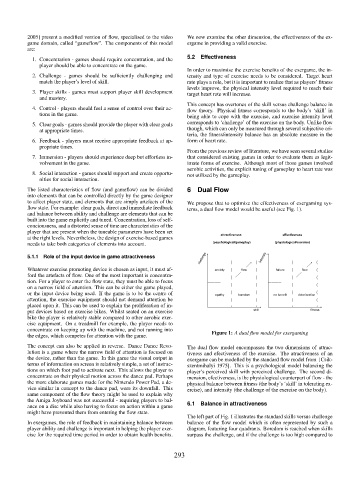
            to affect player state, and elements that are simply artefacts of the  We propose that to optimize the effectiveness of exergaming sys-
            flow state. For example: clear goals, direct and immediate feedback  tems, a dual flow model would be useful (see Fig. 1).
            and balance between ability and challenge are elements that can be
            built into the game explicitly and tuned. Concentration, loss of self-
            conciousness, and a distorted sense of time are characteristics of the
            player that are present when the tuneable parameters have been set
                                                                            attractiveness      effectiveness
            at the right levels. Nevertheless, the design of exercise-based games
            needs to take both categories of elements into account.      (psychological/gameplay)  (physiological/exercise)
                                                                     challenge           intensity
            5.1.1 Role of the input device in game attractiveness
            Whatever exercise promoting device is chosen as input, it must af-  anxiety  flow  failure  flow
            ford the artefacts of flow. One of the most important is concentra-
            tion. For a player to enter the flow state, they must be able to focus
            on a narrow field of attention. This can be either the game played,
            or the input device being used. If the game is to be the centre of  apathy  boredom  no benefit  deterioration
            attention, the exercise equipment should not demand attention be
            placed upon it. This can be used to explain the proliferation of in-
                                                                                       skill             fitness
            put devices based on exercise bikes. Whilst seated on an exercise
            bike the player is relatively stable compared to other aerobic exer-
            cise equipment. On a treadmill for example, the player needs to
            concentrate on keeping up with the machine, and not running into  Figure 1: A dual flow model for exergaming
            the edges, which competes for attention with the game.
            The concept can also be applied in reverse. Dance Dance Revo-  The dual flow model encompasses the two dimensions of attrac-
            lution is a game where the narrow field of attention is focused on  tivness and efectiveness of the exercise. The atractiveness of an
            the device, rather than the game. In this game the visual output in  exergame can be modelled by the standard flow model from [Csik-
            terms of information on screen is relatively simple, a set of instruc-  szentmihalyi 1975]. This is a psychological model balancing the
            tions on which foot pad to activate next. This allows the player to  player’s perceived skill with perceived challenge. The second di-
            concentrate on their physical motion across the dance pad. Perhaps  mension, efectiveness, is the physiological counterpart of flow - the
            the more elaborate games made for the Nintendo Power Pad, a de-  physical balance between fitness (the body’s ‘skill’ in tolerating ex-
            vice similar in concept to the dance pad, were its downfall. This  ercise), and intensity (the challenge of the exercise on the body).
            same component of the flow theory might be used to explain why
            the Amiga Joyboard was not successful - requiring players to bal-
            ance on a disc while also having to focus on action within a game  6.1 Balance in attractiveness
            might have prevented them from entering the flow state.
                                                                 The left part of Fig. 1 illustrates the standard skills versus challenge
            In exergames, the role of feedback in maintaining balance between  balance of the flow model which is often represented by such a
            player ability and challenge is important in helping the player exer-  diagram, featuring four quadrants. Boredom is reached when skills
            cise for the required time period in order to obtain health benefits.  surpass the challenge, and if the challenge is too high compared to


                                                            293
                                                            293

