


Page 28 - MACHINE TOOLS WORLD - September 2021
P. 28
CASE STUDY                                                                          METROLOGY SECTION


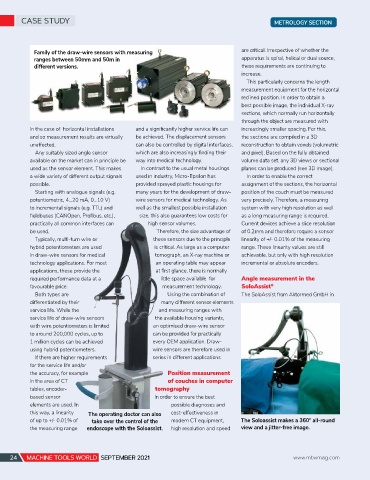
            Family of the draw-wire sensors with measuring                       are critical. Irrespective of whether the
            ranges between 50mm and 50m in                                       apparatus is spiral, helical or dual source,
            different versions.                                                  these requirements are continuing to
                                                                                 increase.
                                                                                   This particularly concerns the length
                                                                                 measurement equipment for the horizontal
                                                                                 reclined position. In order to obtain a
                                                                                 best possible image, the individual X-ray
                                                                                 sections, which normally run horizontally
                                                                                 through the object are measured with
           in the case of  horizontal installations   and a significantly higher service life can   increasingly smaller spacing. For this,
           and so measurement results are virtually   be achieved. The displacement sensors   the sections are compiled in a 3D
           unaffected.                        can also be controlled by digital interfaces,   reconstruction to obtain voxels (volumetric
             Any suitably sized angle sensor   which are also increasingly finding their   and pixel). Based on the fully obtained
           available on the market can in principle be   way into medical technology.  volume data set, any 3D views or sectional
           used as the sensor element. This makes   In contrast to the usual metal housings   planes can be produced (see 3D image).
           a wide variety of different output signals   used in industry, Micro-Epsilon has   In order to enable the correct
           possible.                          provided sprayed plastic housings for   assignment of the sections, the horizontal
             Starting with analogue signals (e.g.   many years for the development of draw-  position of the couch must be measured
           potentiometric, 4...20 mA, 0...10 V)   wire sensors for medical technology. As   very precisely. Therefore, a measuring
           to incremental signals (e.g. TTL) and   well as the smallest possible installation   system with very high resolution as well
           fieldbuses (CANOpen, Profibus, etc.),   size, this also guarantees low costs for   as a long measuring range is required.
           practically all common interfaces can   high sensor volumes.          Current devices achieve a slice resolution
           be used.                                  Therefore, the size advantage of   of 0.2mm and therefore require a sensor
             Typically, multi-turn wire or          these sensors due to the principle   linearity of +/- 0.01% of the measuring
           hybrid potentiometers are used           is critical. As large as a computer   range. These linearity values are still
           in draw-wire sensors for medical         tomograph, an X-ray machine or   achievable, but only with high resolution
           technology applications. For most         an operating table may appear   incremental or absolute encoders.
           applications, these provide the           at first glance, there is normally
           required performance data at a             little space available  for   Angle measurement in the
           favourable price.                           measurement technology.     SoloAssist ®
             Both types are                             Using the combination of   The SoloAssist from Aktormed GmbH in
           differentiated by their                    many different sensor elements
           service life. While the                    and measuring ranges with
           service life of draw-wire sensors        the available housing variants,
           with wire potentiometers is limited      an optimised draw-wire sensor
           to around 200,000 cycles, up to          can be provided for practically
           1 million cycles can be achieved         every OEM application. Draw-
           using hybrid potentiometers.             wire sensors are therefore used in
             If there are higher requirements       series in different applications.
           for the service life and/or
           the accuracy, for example                     Position measurement
           in the area of CT                             of couches in computer
           tables, encoder-                         tomography
           based sensor                             In order to ensure the best
           elements are used. In                          possible diagnoses and
           this way, a linearity   The operating doctor can also   cost-effectiveness in
           of up to +/- 0.01% of   take over the control of the   modern CT equipment,   The Soloassist makes a 360° all-round
           the measuring range   endoscope with the Soloassist.  high resolution and speed   view and a jitter-free image.


     24     MACHINE TOOLS WORLD SEPTEMBER 2021                                                    www.mtwmag.com

