


Page 20 - Critical Care Nursing Demystified
P. 20
Chapter 1  THE CRITICAL CARE NURSE        5


                               Organizations

                               The critical care nurse can be part of many different organizations, from the
                               nurse’s place of employment to local, state, and nationally recognized profes-
                               sional organizations. One of the first places a nurse is employed is the organi-
                               zation the nurse chooses. There are many organizational influences that create
                               job satisfaction for the nurse entering those places. Many studies have been
                               done on what creates a healthy work environment, and the AACN has been
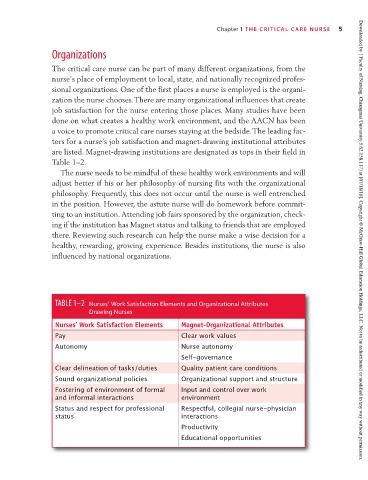
                               a voice to promote critical care nurses staying at the bedside. The leading fac-
                               tors for a nurse’s job satisfaction and magnet-drawing institutional attributes
                               are listed. Magnet-drawing institutions are designated as tops in their field in
                               Table 1–2.
                                 The nurse needs to be mindful of these healthy work environments and will
                               adjust better if his or her philosophy of nursing fits with the organizational
                               philosophy. Frequently, this does not occur until the nurse is well entrenched
                               in the position. However, the astute nurse will do homework before commit-
                               ting to an institution. Attending job fairs sponsored by the organization, check-
                               ing if the institution has Magnet status and talking to friends that are employed
                               there. Reviewing such research can help the nurse make a wise decision for a
                               healthy, rewarding, growing experience. Besides institutions, the nurse is also      Downloaded by [ Faculty of Nursing, Chiangmai University 5.62.158.117] at [07/18/16]. Copyright © McGraw-Hill Global Education Holdings, LLC. Not to be redistributed or modified in any way without permission.
                               influenced by national organizations.


                               TABLE 1–2   Nurses’  Work Satisfaction Elements and Organizational Attributes
                                         Drawing Nurses
                               Nurses’ Work Satisfaction Elements  Magnet-Organizational Attributes
                               Pay                                 Clear work values
                               Autonomy                            Nurse autonomy
                                                                   Self-governance
                               Clear delineation of tasks/duties   Quality patient care conditions
                               Sound organizational policies       Organizational support and structure
                               Fostering of environment of formal   Input and control over work
                               and informal interactions           environment
                               Status and respect for professional   Respectful, collegial nurse-physician
                               status                              interactions
                                                                   Productivity
                                                                   Educational opportunities

