


Page 26 - Critical Care Nursing Demystified
P. 26
Chapter 1  THE CRITICAL CARE NURSE        11


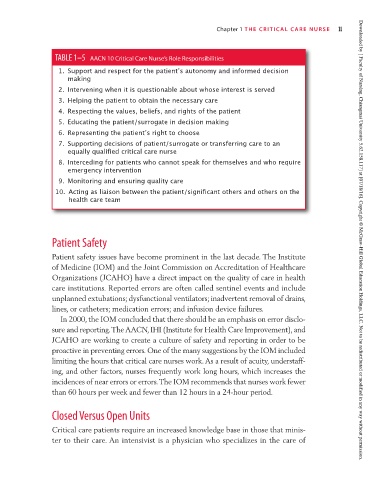
                               TABLE 1–5  AACN 10 Critical Care Nurse’s Role Responsibilities
                                1.  Support and respect for the patientʼs autonomy and informed decision
                                   making
                                 2.  Intervening when it is questionable about whose interest is served
                                 3.  Helping the patient to obtain the necessary care
                                 4.  Respecting the values, beliefs, and rights of the patient
                                 5.  Educating the patient/surrogate in decision making
                                6. Representing the patientʼs right to choose
                                7.  Supporting decisions of patient/surrogate or transferring care to an
                                   equally qualified critical care nurse
                                8.  Interceding for patients who cannot speak for themselves and who require
                                   emergency intervention
                                9.  Monitoring and ensuring quality care
                               10.  Acting as liaison between the patient/significant others and others on the
                                   health care team


                               Patient Safety                                                                       Downloaded by [ Faculty of Nursing, Chiangmai University 5.62.158.117] at [07/18/16]. Copyright © McGraw-Hill Global Education Holdings, LLC. Not to be redistributed or modified in any way without permission.

                               Patient safety issues have become prominent in the last decade. The Institute
                               of Medicine (IOM) and the Joint Commission on Accreditation of Healthcare
                               Organizations (JCAHO) have a direct impact on the quality of care in health
                               care institutions. Reported errors are often called sentinel events and include
                               unplanned extubations; dysfunctional ventilators; inadvertent removal of drains,
                               lines, or catheters; medication errors; and infusion device failures.
                                 In 2000, the IOM concluded that there should be an emphasis on error disclo-
                               sure and reporting. The AACN, IHI (Institute for Health Care Improvement), and
                               JCAHO are working to create a culture of safety and reporting in order to be
                               proactive in preventing errors. One of the many suggestions by the IOM included
                               limiting the hours that critical care nurses work. As a result of acuity, understaff-
                               ing, and other factors, nurses frequently work long hours, which increases the
                               incidences of near errors or errors. The IOM recommends that nurses work fewer
                               than 60 hours per week and fewer than 12 hours in a 24-hour period.


                               Closed Versus Open Units

                               Critical care patients require an increased knowledge base in those that minis-
                               ter to their care. An intensivist is a physician who specializes in the care of

