


Page 302 - Critical Care Nursing Demystified
P. 302
Chapter 6  CARE OF THE  TRAUMATIZED PATIENT        287


                                 NURSING ALERT

                                 There is no single test or diagnostic procedure to confirm a pulmonary contusion,

                                 and often the clinical picture along with a high index of suspicion and close monitor-
                                 ing for signs/symptoms will help in diagnosis.


                               Hallmark Signs and Symptoms


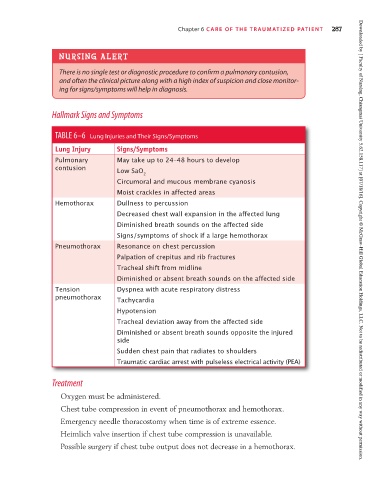
                               TABLE 6–6  Lung Injuries and Their Signs/Symptoms
                               Lung Injury       Signs/Symptoms
                               Pulmonary         May take up to 24–48 hours to develop
                                 contusion       Low SaO
                                                        2
                                                 Circumoral and mucous membrane cyanosis
                                                 Moist crackles in affected areas
                               Hemothorax        Dullness to percussion
                                                 Decreased chest wall expansion in the affected lung
                                                 Diminished breath sounds on the affected side
                                                 Signs/symptoms of shock if a large hemothorax
                               Pneumothorax      Resonance on chest percussion                                      Downloaded by [ Faculty of Nursing, Chiangmai University 5.62.158.117] at [07/18/16]. Copyright © McGraw-Hill Global Education Holdings, LLC. Not to be redistributed or modified in any way without permission.
                                                 Palpation of crepitus and rib fractures
                                                 Tracheal shift from midline
                                                 Diminished or absent breath sounds on the affected side
                               Tension           Dyspnea with acute respiratory distress
                                 pneumothorax    Tachycardia
                                                 Hypotension
                                                 Tracheal deviation away from the affected side
                                                 Diminished or absent breath sounds opposite the injured
                                                 side
                                                 Sudden chest pain that radiates to shoulders
                                                 Traumatic cardiac arrest with pulseless electrical activity (PEA)


                               Treatment
                                 Oxygen must be administered.
                                 Chest tube compression in event of pneumothorax and hemothorax.
                                 Emergency needle thoracostomy when time is of extreme essence.

                                 Heimlich valve insertion if chest tube compression is unavailable.
                                 Possible surgery if chest tube output does not decrease in a hemothorax.

