


Page 308 - Critical Care Nursing Demystified
P. 308
Chapter 6  CARE OF THE  TRAUMATIZED PATIENT        293


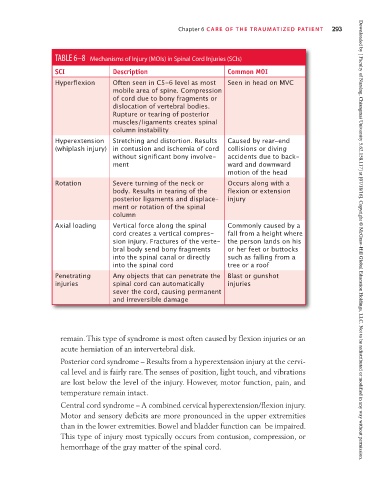
                               TABLE 6–8  Mechanisms of Injury (MOIs) in Spinal Cord Injuries (SCIs)
                               SCI              Description                     Common MOI
                               Hyperflexion     Often seen in C5-6 level as most   Seen in head on MVC
                                                mobile area of spine. Compression
                                                of cord due to bony fragments or
                                                dislocation of vertebral bodies.
                                                Rupture or tearing of posterior
                                                muscles/ligaments creates spinal
                                                column instability
                               Hyperextension   Stretching and distortion. Results   Caused by rear-end
                               (whiplash injury) in contusion and ischemia of cord   collisions or diving
                                                without significant bony involve-  accidents due to back-
                                                ment                            ward and downward
                                                                                motion of the head
                               Rotation         Severe turning of the neck or   Occurs along with a
                                                body. Results in tearing of the   flexion or extension
                                                posterior ligaments and displace-  injury
                                                ment or rotation of the spinal
                                                  column
                               Axial loading    Vertical force along the spinal   Commonly caused by a
                                                cord creates a vertical compres-  fall from a height where
                                                sion injury. Fractures of the verte-  the person lands on his       Downloaded by [ Faculty of Nursing, Chiangmai University 5.62.158.117] at [07/18/16]. Copyright © McGraw-Hill Global Education Holdings, LLC. Not to be redistributed or modified in any way without permission.
                                                bral body send bony fragments   or her feet or buttocks
                                                into the spinal canal or directly   such as falling from a
                                                into the spinal cord            tree or a roof
                               Penetrating      Any objects that can penetrate the  Blast or gunshot
                               injuries         spinal cord can automatically     injuries
                                                sever the cord, causing permanent
                                                and irreversible damage


                                 remain. This type of syndrome is most often caused by flexion injuries or an
                                 acute herniation of an intervertebral disk.
                                 Posterior cord syndrome – Results from a hyperextension injury at the cervi-
                                 cal level and is fairly rare. The senses of position, light touch, and vibrations
                                 are lost below the level of the injury. However, motor function, pain, and
                                 temperature remain intact.
                                 Central cord syndrome – A combined cervical hyperextension/flexion injury.
                                 Motor and sensory deficits are more pronounced in the upper extremities
                                 than in the lower extremities. Bowel and bladder function can  be impaired.
                                 This type of injury most typically occurs from contusion, compression, or
                                 hemorrhage of the gray matter of the spinal cord.

