


Page 76 - Critical Care Nursing Demystified
P. 76
Chapter 2  CARE OF THE PATIENT WITH CRITICAL RESPIRATORY NEEDS        61


                               Paralytics (Neuromuscular Blocking Agents)

                               Neuromuscular blocking agents (NMBAs) are frequently used in the critical care
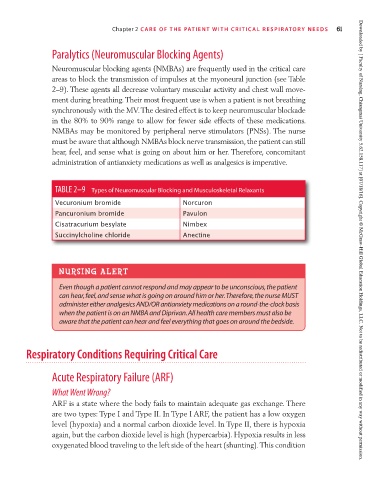
                               areas to block the transmission of impulses at the myoneural junction (see Table
                               2–9). These agents all decrease voluntary muscular activity and chest wall move-
                               ment during breathing. Their most frequent use is when a patient is not breathing
                               synchronously with the MV. The desired effect is to keep neuromuscular blockade
                               in the 80% to 90% range to allow for fewer side effects of these medications.
                               NMBAs may be monitored by peripheral nerve stimulators (PNSs). The nurse
                               must be aware that although NMBAs block nerve transmission, the patient can still
                               hear, feel, and sense what is going on about him or her. Therefore, concomitant
                               administration of antianxiety medications as well as analgesics is imperative.


                               TABLE 2–9   Types of Neuromuscular Blocking and Musculoskeletal Relaxants
                               Vecuronium bromide                  Norcuron
                               Pancuronium bromide                 Pavulon
                               Cisatracurium besylate              Nimbex
                               Succinylcholine chloride            Anectine                                         Downloaded by [ Faculty of Nursing, Chiangmai University 5.62.158.117] at [07/18/16]. Copyright © McGraw-Hill Global Education Holdings, LLC. Not to be redistributed or modified in any way without permission.


                                 NURSING ALERT

                                 Even though a patient cannot respond and may appear to be unconscious, the patient
                                 can hear, feel, and sense what is going on around him or her. Therefore, the nurse MUST
                                 administer either analgesics AND/OR antianxiety medications on a round-the-clock basis
                                 when the patient is on an NMBA and Diprivan. All health care members must also be
                                 aware that the patient can hear and feel everything that goes on around the bedside.


                       Respiratory Conditions Requiring Critical Care


                               Acute Respiratory Failure (ARF)
                               What Went Wrong?
                               ARF is a state where the body fails to maintain adequate gas exchange. There
                               are two types: Type I and Type II. In Type I ARF, the patient has a low oxygen
                               level (hypoxia) and a normal carbon dioxide level. In Type II, there is hypoxia
                               again, but the carbon dioxide level is high (hypercarbia). Hypoxia results in less
                               oxygenated blood traveling to the left side of the heart (shunting). This condition

