


Page 1135 - Hall et al (2015) Principles of Critical Care-McGraw-Hill
P. 1135
774     PART 6: Neurologic Disorders


                                                                       controlled clinical trials failed to demonstrate a benefit of intravenous
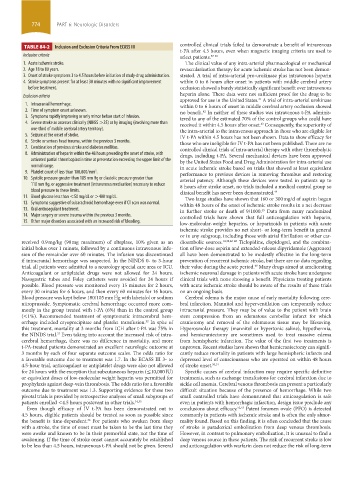
                   TABLE 84-2    Inclusion and Exclusion Criteria From ECASS III
                                                                       t-PA after 4.5 hours, even when magnetic imaging criteria are used to
                  Inclusion criteria                                   select patients. 37-40
                  1.  Acute ischemic stroke.                             The clinical value of any intra-arterial pharmacological or mechanical
                  2.  Age 18 to 80 years.                              revascularization therapy for acute ischemic stroke has not been demon-
                  3.  Onset of stroke symptoms 3 to 4.5 hours before initiation of study-drug administration.  strated. A trial of intra-arterial pro-urokinase plus intravenous heparin
                  4.   Stroke symptoms present for at least 30 minutes with no significant improvement   within 0 to 6 hours after onset in patients with middle cerebral artery
                    before treatment.                                  occlusion showed a barely statistically significant benefit over intravenous
                  Exclusion criteria                                   heparin alone. These data were not sufficient proof for the drug to be
                                                                       approved for use in the United States.  A trial of intra-arterial urokinase
                                                                                                  41
                    1.  Intracranial hemorrhage.                       within 0 to 6 hours of onset in middle cerebral artery occlusion showed
                    2.  Time of symptom onset unknown.                 no benefit.  In neither of these studies was intravenous t-PA adminis-
                                                                               42
                    3.  Symptoms rapidly improving or only minor before start of infusion.  tered to any of the estimated 70% of the control groups who could have
                    4.  Severe stroke as assesses clinically (NIHSS >25) or by imaging (involving more than    received it within 4.5 hours after onset.  Consequently, the superiority of
                                                                                                   43
                    one-third of middle cerebral artery territory).    the intra-arterial to the intravenous approach in those who are eligible for
                    5.  Seizure at the onset of stroke.                IV t-PA within 4.5 hours has not been shown. Data to show efficacy for
                    6.  Stroke or serious head trauma, within the previous 3 months.  those who are ineligible for IV t-PA has not been published. There are no
                    7.  Combination of previous stroke and diabetes mellitus.  controlled clinical trials of intra-arterial therapy with other thrombolytic
                    8.  Administration of heparin within the 48 hours preceding the onset of stroke, with   drugs, including t-PA. Several mechanical devices have been approved
                    activated partial thromboplastin time at presentation exceeding the upper limit of the   by the United States Food and Drug Administration for intra-arterial use
                    normal range.                                      in acute ischemic stroke based on trials that showed at least equivalent
                    9.  Platelet count of less than 100,000/mm . 3     performance to previous devices in removing thrombus and restoring
                    10.  Systolic pressure greater than 185 mm Hg or diastolic pressure greater than     arterial patency. Although these devices were tested in patients up to
                    110 mm Hg, or aggressive treatment (intravenous medication) necessary to reduce   8 hours after stroke onset, no trials included a medical control group so
                    blood pressure to these limits.                    clinical benefit has never been demonstrated. 44
                    11.  Blood glucose less than <50 mg/dL or >400 mg/dL.  Two large studies have shown that 160 or 300 mg/d of aspirin begun
                    12.  Symptoms suggestive of subarachnoid hemorrhage even if CT scan was normal.  within 48 hours of the onset of ischemic stroke results in a net decrease
                    13.  Oral anticoagulant treatment.                 in further stroke or death of 9/1000.  Data from many randomized
                                                                                                   45
                    14.  Major surgery or severe trauma within the previous 3 months.  controlled trials have shown that full anticoagulation with heparin,
                    15.  Other major disorders associated with an increased risk of bleeding.
                                                                       low-molecular-weight heparins, or heparinoids in patients with acute
                                                                       ischemic stroke provides no net short- or long-term benefit in general
                                                                       or in any subgroup, including those with atrial fibrillation or other car-
                 received  0.9 mg/kg (90 mg maximum) of alteplase, 10% given as an   dioembolic sources. 14,30,46-48  Ticlopidine, clopidogrel, and the combina-
                 initial bolus over 1 minute, followed by a continuous intravenous infu-  tion of low-dose aspirin and extended-release dipyridamole (Aggrenox)
                 sion of the remainder over 60 minutes. The infusion was discontinued   all have been demonstrated to be modestly effective in the long-term
                 if intracranial hemorrhage was suspected. In the NINDS 0- to 3-hour   prevention of recurrent ischemic stroke, but there are no data regarding
                 trial, all patients were admitted to a neurology special care area or ICU.   their value during the acute period.  Many drugs aimed at ameliorating
                                                                                                 49
                 Anticoagulant or antiplatelet drugs were not allowed for 24 hours.   ischemic neuronal damage in patients with acute stroke have undergone
                 Nasogastric tubes and Foley catheters were avoided for 24 hours if   clinical trials with none showing a benefit. Physicians treating patients
                   possible. Blood pressure was monitored every 15 minutes for 2 hours,   with acute ischemic stroke should be aware of the results of these trials
                 every 30 minutes for 6 hours, and then every 60 minutes for 16 hours.   on an ongoing basis.
                 Blood pressure was kept below 180/105 mm Hg with labetalol or sodium   Cerebral edema is the major cause of early mortality following cere-
                 nitroprusside. Symptomatic cerebral hemorrhage occurred more com-  bral infarction. Mannitol and hyperventilation can temporarily reduce
                 monly in the group treated with t-PA (6%) than in the control group   intracranial pressure. They may be of value to the patient with brain
                 (<1%). Recommended treatment of symptomatic intracerebral hem-  stem compression from an edematous cerebellar infarct for which
                 orrhage included cryoprecipitate and platelet transfusion.  In spite of   craniotomy and removal of the edematous tissue may be lifesaving.
                                                           32
                 this treatment, mortality at 3 months from ICH after t-PA was 75% in   Hyperosmolar  therapy  (mannitol  or  hypertonic  saline),  hypothermia,
                 the NINDS trial.  Even taking into account the increased risk of intra-  and hemicraniectomy are sometimes used to treat massive edema
                             33
                 cerebral hemorrhage,  there  was no difference  in  mortality, and more   from hemispheric infarction. The value of the first two treatments is
                 t-PA-treated patients demonstrated an excellent neurologic outcome at   unproven. Recent studies have shown that hemicraniectomy can signifi-
                 3 months by each of four separate outcome scales. The odds ratio for   cantly reduce mortality in patients with large hemispheric infarcts and
                 a favorable outcome due to treatment was 1.7. In the ECASS III 3- to   depressed level of consciousness who are operated on within 48 hours
                 4.5-hour trial, anticoagulant or antiplatelet drugs were also not allowed   of stroke onset. 50,51
                 for 24 hours with the exception that subcutaneous heparin (≤10,000 IU)   Specific causes of cerebral infarction may require specific definitive
                 or equivalent doses of low-molecular weight heparin was permitted for   treatments, such as exchange transfusions for cerebral infarction due to
                 prophylaxis against deep-vein thrombosis. The odds ratio for a favorable   sickle cell anemia. Cerebral venous thrombosis can present a particularly
                 outcome due to treatment was 1.3. Supporting evidence for these two   difficult situation because of the presence of hemorrhage. While two
                 pivotal trials is provided by retrospective analyses of small subgroups of   small controlled trials have demonstrated that anticoagulation is safe
                 patients enrolled <4.5 hours postevent in other trials. 34,35  even in patients with hemorrhagic infarction, design issue preclude any
                   Even though efficacy of IV t-PA has been demonstrated out to   conclusions about efficacy. 52,53  Patent foramen ovale (PFO) is detected
                 4.5 hours, eligible patients should be treated as soon as possible since   commonly in patients with ischemic stroke and is often the only abnor-
                 the benefit is time-dependent.  For patients who awaken from sleep   mality found. Based on this finding, it is often concluded that the cause
                                        36
                 with a stroke, the time of onset must be taken to be the last time they   of stroke is paradoxical embolization from deep venous thrombosis.
                 were awake and known to be in their premorbid state, not the time of   However, in contrast to pulmonary embolization, it is unusual to find a
                 awakening. If the time of stroke onset cannot accurately be established   deep venous source in these patients. The risk of recurrent stroke is low
                 to be less than 4.5 hours, intravenous t-PA should not be given. Several   and anticoagulation with warfarin does not reduce the risk of long-term


            section06.indd   774                                                                                       1/23/2015   12:55:33 PM

