


Page 15 - Psychology of Wounds and Wound Care in Clinical Practice ( PDFDrive )
P. 15
xiv  Preface

           long wound treatment by delaying healing and thereby
           increasing mood disorders, decreasing quality of life and
           increasing treatment costs. It is clear, therefore, that the psy-
           chological consequences of wounds are severe and that the
           psychological components of wound care are significant. This
           text seeks to address these two linked issues in one up-to-
           date book and, building on contemporary research evidence,
           present practical clinical guidelines for all clinicians involved
           in wound care.
              The role of psychology in nursing and medical practice has
           become ever more significant in recent years, and this is
           reflected in various policy documents, educational develop-
           ments and practice focus. Similarly, research exploring the role
           of psychology in wounds and wound care has grown consider-
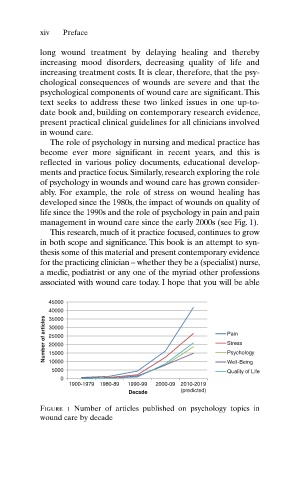
           ably. For example, the role of stress on wound healing has
           developed since the 1980s, the impact of wounds on quality of
           life since the 1990s and the role of psychology in pain and pain
           management in wound care since the early 2000s (see Fig.   1 ).
                This research, much of it practice focused, continues to grow
           in both scope and significance. This book is an attempt to syn-
           thesis some of this material and present contemporary evidence
           for the practicing clinician – whether they be a (specialist) nurse,
           a medic, podiatrist or any one of the myriad other professions
           associated with wound care today. I hope that you will be able

             45000
             40000
            Number of articles  30000                   Pain
             35000
             25000
                                                        Stress
             20000
                                                        Psychology
             15000
             10000
             5000                                       Well-Being
                                                        Quality of Life
                0
                  1900-1979  1980-89  1990-99  2000-09  2010-2019
                                Decade      (predicted)
             Figure  1     Number of articles published on psychology topics in
           wound care by decade

