


Page 553 - Clinical Application of Mechanical Ventilation
P. 553
Weaning from Mechanical Ventilation  519


                                             ventilation (.72 hours), and upper airway disorders are some key factors that affect
                                             the weaning outcome (Boles et al., 2007).
                                             Impact of Weaning Failure. It is obvious that patients who require prolonged venti-
                                             lator support have a severe impact on the use of health care resources, including
                                             financial, physical, and human resources. In addition, the longer a patient stays on
                                             the ventilator, emotional and psychological pains also take a toll. For these reasons,
                                             different strategies have been devised to enhance the weaning process. These strate-
                                             gies are designed to minimize the use of limited resources, and to keep the patients
                                             from the uncomfortable and sometimes painful diagnostic and therapeutic proce-
                                             dures associated with mechanical ventilation.


                        PATIENT CONDITION PRIOR TO WEANING


                                             Perhaps the first consideration before any weaning attempt is to assess the patient’s
                            Before weaning, the   overall clinical status. Two important questions pertaining to the patient’s clinical
                          patient should have recovered   condition are (1) Has the patient significantly recovered from the acute phase of the
                          from the acute phase of the
                          disease leading to mechanical   disease or injury that prompted the need for mechanical ventilation? (2) Are there
                          ventilation and be able to as-  other clinical conditions that may interfere with the patient’s ability to sustain the
                          sume adequate spontaneous
                          breathing.         work of spontaneous breathing?
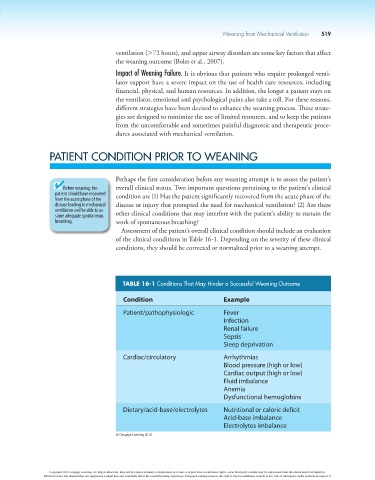
                                               Assessment of the patient’s overall clinical condition should include an evaluation
                                             of the clinical conditions in Table 16-1. Depending on the severity of these clinical
                                             conditions, they should be corrected or normalized prior to a weaning attempt.


                                                TABLE 16-1 Conditions That May Hinder a Successful Weaning Outcome

                                                Condition                        Example

                                                Patient/pathophysiologic         Fever
                                                                                 Infection
                                                                                 Renal failure
                                                                                 Sepsis
                                                                                 Sleep deprivation
                                                Cardiac/circulatory              Arrhythmias
                                                                                 Blood pressure (high or low)
                                                                                 Cardiac output (high or low)
                                                                                 Fluid imbalance
                                                                                 Anemia
                                                                                 Dysfunctional hemoglobins

                                                Dietary/acid-base/electrolytes   Nutritional or caloric deficit
                                                                                 Acid-base imbalance
                                                                                 Electrolytes imbalance
                                             © Cengage Learning 2014


                        Copyright 2013 Cengage Learning. All Rights Reserved. May not be copied, scanned, or duplicated, in whole or in part. Due to electronic rights, some third party content may be suppressed from the eBook and/or eChapter(s).
                      Editorial review has deemed that any suppressed content does not materially affect the overall learning experience. Cengage Learning reserves the right to remove additional content at any time if subsequent rights restrictions require it.

