


Page 732 - Clinical Application of Mechanical Ventilation
P. 732
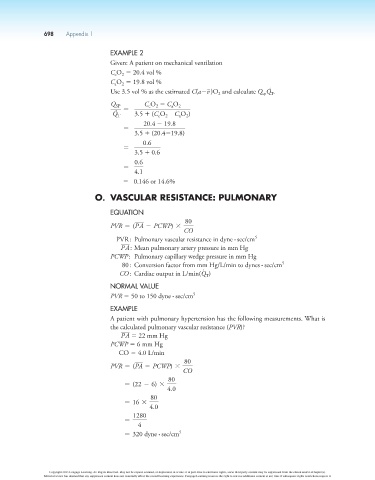
698    Appendix 1


                                            EXAMPLE 2
                                            Given: A patient on mechanical ventilation
                                            C O  5 20.4 vol %
                                               2
                                             c
                                            C O  5 19.8 vol %                                   #
                                               2
                                             a
                                            Use 3.5 vol % as the estimated C(a2v )O  and calculate Q Q .
                                                                               2
                                                                                             sp
                                                                                                T
                                            Q . SP  =     C O  - C O 2
                                                          2
                                                        c
                                                               a
                                            Q T     3.5 + (C O  C O )
                                                              2
                                                                  a
                                                                    2
                                                           c
                                                      20.4 - 19.8
                                                =
                                                   3.5 + (20.4-19.8)
                                                      0.6
                                                =
                                                   3.5 + 0.6
                                                   0.6
                                                =
                                                   4.1
                                                5   0.146 or 14.6%
                                       O.	 VAsCulAr	resistAnCe:	PulmOnAry
                                            EQUATION
                                                                    80
                                            PVR = (P A - PCWP) *
                                                                    CO
                                             PVR :  Pulmonary vascular resistance in dyne   sec/cm 5
                                               P A : Mean pulmonary artery pressure in mm Hg
                                            PCWP :  Pulmonary capillary wedge pressure in mm Hg
                                               80 :  Conversion factor from mm Hg/L/min to dynes   sec/cm 5
                                                                          #
                                               CO :  Cardiac output in L/min(Q )
                                                                           T
                                            NORMAL VALUE
                                            PVR 5 50 to 150 dyne   sec/cm 5
                                            EXAMPLE
                                            A patient with pulmonary hypertension has the following measurements. What is
                                            the calculated pulmonary vascular resistance (PVR)?
                                               P A 5 22 mm Hg
                                            PCWP 5 6 mm Hg
                                              CO 5 4.0 L/min
                                                                    80
                                            PVR = (PA - PCWP) *
                                                                   CO
                                                               80
                                                = (22 - 6) *
                                                              4.0
                                                         80
                                                = 16 *
                                                        4.0
                                                   1280
                                                =
                                                     4
                                                   = 320 dyne   sec/cm 5


                        Copyright 2013 Cengage Learning. All Rights Reserved. May not be copied, scanned, or duplicated, in whole or in part. Due to electronic rights, some third party content may be suppressed from the eBook and/or eChapter(s).
                      Editorial review has deemed that any suppressed content does not materially affect the overall learning experience. Cengage Learning reserves the right to remove additional content at any time if subsequent rights restrictions require it.

