


Page 90 - AACN Essentials of Critical-Care Nursing Pocket Handbook, Second Edition
P. 90
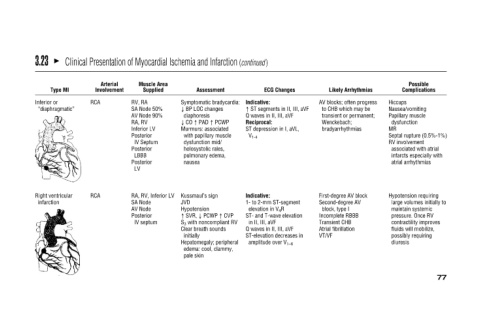
Possible  Complications  Septal rupture (0.5%-1%)  associated with atrial  infarcts especially with   atrial arrhythmias  Hypotension requiring  large volumes initially to  maintain systemic  pressure. Once RV   contractility improves   fluids wi

                       Hiccups  Nausea/vomiting  Papillary muscle   dysfunction  MR  RV involvement   diuresis


                    Likely Arrhythmias   AV blocks; often progress  to CHB which may be transient or permanent;   Wenckebach;  bradyarrhythmias  First-degree AV block  Second-degree AV   block, type I  Incomplete RBBB  Transient CHB  Atrial fibrillation  VT/VF


                    ECG Changes  ↑ ST segments in II, III, aVF  Q waves in II, III, aVF  ST depression in I, aVL,  1- to 2-mm ST-segment  ST- and T-wave elevation  Q waves in II, III, aVF ST-elevation decreases in  amplitude over V 1–6


                       Indicative:  Reciprocal:  V 1-4  Indicative:  elevation in V 4 R  in II, III, aVF
               Clinical Presentation of Myocardial Ischemia and Infarction (continued)


                    Assessment  Symptomatic bradycardia:  ↓ BP LOC changes   diaphoresis  ↓ CO ↑ PAD ↑ PCWP  Murmurs: associated   with papillary muscle   dysfunction mid/  holosystolic rales,   pulmonary edema,  nausea  Kussmaul’s sign  JVD  Hypotension  ↑ SVR, ↓


                   Muscle Area  Supplied  RV, RA  SA Node 50%  AV Node 90%  RA, RV  Inferior LV  Posterior  IV Septum  Posterior  LBBB  Posterior  LV  RA, RV, Inferior LV  SA Node  AV Node  Posterior  IV septum


                   Arterial  Involvement  RCA  RCA


                    Type MI
                        “diaphragmatic”    Right ventricular
               3.23    Inferior or          infarction

