


Page 915 - Cardiac Nursing
P. 915
LWBK340-c40_p889-905.qxd  29/06/2009  10:17 PM  Page 891 Aptara


                                                       C HAP TE R 4 0 / Adherence to Cardiovascular Treatment Regimens  891


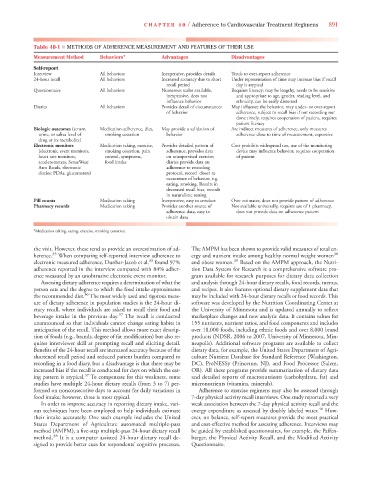
                   Table 40-1 ■ METHODS OF ADHERENCE MEASUREMENT AND FEATURES OF THEIR USE
                   Measurement Method    Behaviors*          Advantages             Disadvantages
                   Self-report
                   Interview             All behaviors       Inexpensive, provides details  Tends to over-report adherence
                   24-hour recall        All behaviors       Increased accuracy due to short  Under representation of time may increase bias if recall
                                                              recall period          day is atypical
                   Questionnaire         All behaviors       Numerous scales available,   Requires literacy; may be lengthy, needs to be sensitive
                                                              inexpensive, does not   and appropriate to age, gender, reading level, and
                                                              influence behavior      ethnicity, can be easily distorted
                   Diaries               All behaviors       Provides detail of circumstances  May influence the behavior, may under- or over-report
                                                              of behavior            adherence, subject to recall bias if not recording not
                                                                                     done timely, requires cooperation of patient, requires
                                                                                     patient literacy
                   Biologic outcomes (serum,  Medication-adherence, diet,   May provide a validation of   Are indirect measures of adherence, only measures
                     urine, or saliva level of   smoking cessation  behavior         adherence close to time of measurement, expensive
                     drug or its metabolite)
                   Electronic monitors   Medication taking, exercise,   Provides detailed pattern of   Cost prohibits widespread use, use of the monitoring
                     (electronic event monitors,  smoking cessation, pain   adherence, provides data    device may influence behavior, requires cooperation
                     heart rate monitors,   control, symptoms,   on unsupervised exercise;    of patient
                     accelerometers, SenseWear  food intake   diaries provide data on
                     Arm Bands, electronic                    adherence to recording
                     diaries: PDAs, glucometers)              protocol, record  closer to
                                                              occurrence of behavior, e.g.
                                                              eating, smoking. Results in
                                                              decreased recall bias, records
                                                              in naturalistic setting
                   Pill counts           Medication taking   Inexpensive, easy to conduct  Over estimates, does not provide pattern of adherence
                   Pharmacy records      Medication taking   Provides another source of   Not available universally, requires use of 1 pharmacy,
                                                              adherence data, easy to   does not provide data on adherence pattern
                                                              obtain data

                   *Medication taking, eating, exercise, smoking cessation.


                   the visit. However, these tend to provide an overestimation of ad-  The AMPM has been shown to provide valid measures of total en-
                   herence. 35  When comparing self-reported interview adherence to  ergy and nutrient intake among healthy normal weight women 38
                   electronic measured adherence, Dunbar-Jacob et al. 35  found 97%  and obese women. 39  Based on the AMPM approach, the Nutri-
                   adherence reported in the interview compared with 84% adher-  tion Data System for Research is a comprehensive software pro-
                   ence measured by an unobtrusive electronic event monitor.  gram available for research purposes for dietary data collection
                     Assessing dietary adherence requires a determination of what the  and analysis through 24-hour dietary recalls, food records, menus,
                   person eats and the degree to which the food intake approximates  and recipes. It also features optional dietary supplement data that
                                    36
                   the recommended diet. The most widely used and rigorous meas-  may be included with 24-hour dietary recalls or food records. This
                   ure of dietary adherence in population studies is the 24-hour di-  software was developed by the Nutrition Coordinating Center at
                   etary recall, where individuals are asked to recall their food and  the University of Minnesota and is updated annually to reflect
                   beverage intake in the previous day. 37  The recall is conducted  marketplace changes and new analytic data. It contains values for
                   unannounced so that individuals cannot change eating habits in  155 nutrients, nutrient ratios, and food components and includes
                   anticipation of the recall. This method allows more exact descrip-  over 18,000 foods, including ethnic foods and over 8,000 brand
                   tion of foods (e.g., brands, degree of fat modification) but also re-  products (NDSR, 2006 to 2007, University of Minnesota, Min-
                   quires interviewer skill at prompting recall and eliciting detail.  neapolis). Additional software programs are available to collect
                   Benefits of the 24-hour recall are increased accuracy because of the  dietary data, for example, the United States Department of Agri-
                   shortened recall period and reduced patient burden compared to  culture Nutrient Database for Standard Reference (Washington,
                   recording in a food diary, but a disadvantage is that there may be  DC), ProNESSy (Princeton, NJ), and Food Processor (Salem,
                   increased bias if the recall is conducted for days on which the eat-  OR). All these programs provide summarization of dietary data
                   ing pattern is atypical. 37  To compensate for this weakness, some  and detailed reports of macronutrients (carbohydrate, fat) and
                   studies have multiple 24-hour dietary recalls (from 3 to 7) per-  micronutrients (vitamins, minerals).
                   formed on nonconsecutive days to account for daily variations in  Adherence to exercise regimens may also be assessed through
                   food intake; however, three is most typical.        7-day physical activity recall interviews. One study reported a very
                     In order to improve accuracy in reporting dietary intake, vari-  weak association between the 7-day physical activity recall and the
                   ous techniques have been employed to help individuals estimate  energy expenditure as assessed by doubly labeled water. 40  How-
                   their intake accurately. One such example includes the United  ever, on balance, self-report measures provide the most practical
                   States Department of Agriculture automated multiple-pass  and cost-effective method for assessing adherence. Interviews may
                   method (AMPM), a five-step multiple-pass 24-hour dietary recall  be guided by established questionnaires, for example, the Paffen-
                   method. 38  It is a computer assisted 24-hour dietary recall de-  barger, the Physical Activity Recall, and the Modified Activity
                   signed to provide better cues for respondents’ cognitive processes.  Questionnaire.

