


Page 958 - Cardiac Nursing
P. 958
009
                                            1
                                       2
                                    0
                                     6
                                                 A
                                                 A
                                                 A
                                             2:0
                                               4 A
                             qx
                               d
                          37.
                     p93
                        3-9
                                   /
                                   /
                                  0
                               d
                                 3
                                                 A
                                                               ara
                  43_
                                                         34
                                                            Apt
                0-c
         LWBK340-c43_p933-937.qxd  30/06/2009  12:04 AM  Page 934 Aptara
         L L LWB K34 0-c 43_ p93 3-9 37. qx d  3 0 / 0 6 / / / 2 009  1 2:0 4 A M  Pa g g e 9 34  Apt ara
            K34
         LWB
                                                       e 9
                                                 A
                                                 A
                                                 A
                                                 A
                                                 A
                                                  M
                                                    Pa
                                                 A
                  934    PA R T  V / Health Promotion and Disease Prevention
                                                    Communicable diseases,
                    Cancer + chronic                 maternal and perinatal
                  respiratory diseases +            conditions and nutritional
                       diabetes                          deficiencies
                         22%                               30%
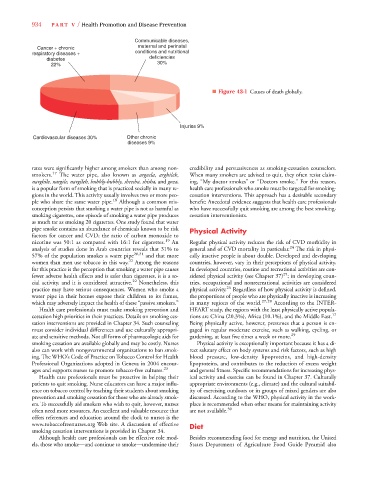
                                                                             ■ Figure 43-1 Causes of death globally.
                                                                   Injuries 9%
                   Cardiovascular diseases 30%   Other chronic
                                                  diseases 9%
                  rates were significantly higher among smokers than among non-  credibility and persuasiveness as smoking-cessation counselors.
                  smokers.  17  The water pipe, also  known as argeela, arghileh,  When many smokers are advised to quit, they often resist claim-
                       e
                       e
                  narghile, nargile, nargileh, hubbly-bubbly, sheesha, shisha, and goza,  ing, “My doctor smokes” or “Doctors smoke.” For this reason,
                                               y
                                               y
                             e
                             e
                  is a popular form of smoking that is practiced socially in many re-  health care professionals who smoke must be targeted for smoking-
                  gions in the world. This activity usually involves two or more peo-  cessation interventions. This approach has a desirable secondary
                  ple who share the same water pipe. 18  Although a common mis-  benefit: Anecdotal evidence suggests that health care professionals
                  conception persists that smoking a water pipe is not as harmful as  who have successfully quit smoking are among the best smoking-
                  smoking cigarettes, one episode of smoking a water pipe produces  cessation interventionists.
                  as much tar as smoking 20 cigarettes. One study found that water
                  pipe smoke contains an abundance of chemicals known to be risk  Physical Activity
                  factors for cancer and CVD; the ratio of carbon monoxide to
                  nicotine was 50:1 as compared with 16:1 for cigarettes. 19  An  Regular physical activity reduces the risk of CVD morbidity in
                  analysis of studies done in Arab countries reveals that 31% to  general and of CVD mortality in particular. 24  The risk in physi-
                  57% of the population smokes a water pipe 20,21  and that more  cally inactive people is about double. Developed and developing
                  women than men use tobacco in this way. 22  Among the reasons  countries, however, vary in their perceptions of physical activity.
                  for this practice is the perception that smoking a water pipe causes  In developed countries, routine and recreational activities are con-
                                                                                                     25
                  fewer adverse health effects and is safer than cigarettes, it is a so-  sidered physical activity (see Chapter 37) ; in developing coun-
                  cial activity, and it is considered attractive. 22  Nonetheless, this  tries, occupational and nonrecreational activities are considered
                  practice may have serious consequences. Women who smoke a  physical activity. 26  Regardless of how physical activity is defined,
                  water pipe in their homes expose their children to its fumes,  the proportions of people who are physically inactive is increasing
                  which may adversely impact the health of these “passive smokers.”  in many regions of the world. 27,28  According to the INTER-
                     Health care professionals must make smoking prevention and  HEART study, the regions with the least physically active popula-
                  cessation high priorities in their practices. Details on smoking ces-  tions are China (20.3%), Africa (10.1%), and the Middle East. 17
                  sation interventions are provided in Chapter 34. Such counseling  Being physically active, however, presumes that a person is en-
                  must consider individual differences and use culturally appropri-  gaged in regular moderate exercise, such as walking, cycling, or
                  ate and sensitive methods. Not all forms of pharmacologic aids for  gardening, at least five times a week or more. 29
                  smoking cessation are available globally and may be costly. Nurses  Physical activity is exceptionally important because it has a di-
                  also can work with nongovernmental organizations to ban smok-  rect salutary effect on body systems and risk factors, such as high
                  ing. The WHO’s Code of Practice on Tobacco Control for Health  blood pressure, low-density lipoproteins, and high-density
                  Professional Organizations adopted in Geneva in 2004 encour-  lipoproteins, and contributes to the reduction of excess weight
                  ages and supports nurses to promote tobacco-free cultures. 23  and general fitness. Specific recommendations for increasing phys-
                     Health care professionals must be proactive in helping their  ical activity and exercise can be found in Chapter 37. Culturally
                  patients to quit smoking. Nurse educators can have a major influ-  appropriate environments (e.g., climate) and the cultural suitabil-
                  ence on tobacco control by teaching their students about smoking  ity of exercising outdoors or in groups of mixed genders are also
                  prevention and smoking cessation for those who are already smok-  discussed. According to the WHO, physical activity in the work-
                  ers. To successfully aid smokers who wish to quit, however, nurses  place is recommended when other means for maintaining activity
                  often need more resources. An excellent and valuable resource that  are not available. 30
                  offers references and education around the clock to nurses is the
                  www.tobaccofreenurses.org Web site. A discussion of effective  Diet
                  smoking cessation interventions is provided in Chapter 34.
                     Although health care professionals can be effective role mod-  Besides recommending food for energy and nutrition, the United
                  els, those who smoke—and continue to smoke—undermine their  States Department of Agriculture Food Guide Pyramid also

