


Page 76 - APPENDIX B: Trials Investigating the Management of Acute Radiation-Induced Skin Reactions Reading Qualitative Research
P. 76
76
               WOUND CARE

                were missing from the completed surveys.  This missing data may be the result of an

                institutional policy on information management that restricts the sharing of organizational


                documents.  Polit and Beck (2012) suggests, “In interpreting results, the risk for various biases

                should be assessed and factored into conclusions” (p. 476).  Based on the survey results, it may


                be concluded that the extent of the missing and “don’t know” responses in the complete

                responses are limited and therefore the extent of the problem in relation to reporting bias is


                minimal.


               Phase III Interview Findings

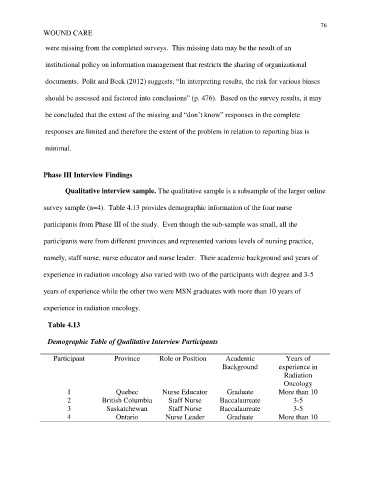
                       Qualitative interview sample. The qualitative sample is a subsample of the larger online


               survey sample (n=4).  Table 4.13 provides demographic information of the four nurse

               participants from Phase III of the study.  Even though the sub-sample was small, all the


               participants were from different provinces and represented various levels of nursing practice,

               namely, staff nurse, nurse educator and nurse leader.  Their academic background and years of


               experience in radiation oncology also varied with two of the participants with degree and 3-5

               years of experience while the other two were MSN graduates with more than 10 years of


               experience in radiation oncology.

                 Table 4.13


                 Demographic Table of Qualitative Interview Participants

                   Participant         Province       Role or Position      Academic            Years of
                                                                           Background        experience in
                                                                                               Radiation
                                                                                               Oncology
                       1               Quebec          Nurse Educator       Graduate         More than 10
                       2           British Columbia      Staff Nurse      Baccalaureate           3-5
                       3            Saskatchewan         Staff Nurse      Baccalaureate           3-5
                       4               Ontario          Nurse Leader        Graduate         More than 10

