


Page 212 - Concise Pathology for Exam Preparation ( PDFDrive )
P. 212
8  Genetic and Paediatric Disorders  197


               2.  Autosomal recessive (AR) disorders
                 (a)  Largest group of Mendelian disorders.
                  (b)  Both  abnormal  alleles  must  be  present  (homozygous  state)  to  express  the
                   disease.
                 (c)  The trait does not always affect the parents but siblings may be affected.
                  (d)  The chance siblings getting affected is one in four.
                 (e)  May result from a consanguineous marriage.
                 (f)  The expression of the defect appears to be more uniform than in AD disorders.
                 (g)  Complete penetrance is common.
                  (h)  Onset is frequently early in life.
                 (i)  Because  the  affected  individual  may  be  an  asymptomatic  heterozygote,  new
                   mutations are rarely discovered clinically; several generations may pass before the
                   descendants of such a person mates with other heterozygotes.
               Examples: Haemochromatosis,  sickle  cell  anaemia,  cystic  fibrosis,  Tay–Sachs  disease,
                 phenylketonuria,  21-hydroxylase  deficiency,  albinism,  mucopolysaccharidoses
                 (except Hunter syndrome), glycogenoses and galactosaemia.
               Lysosomal storage diseases are a group of diseases in which the absence of degrad-
                 ing  enzymes  leads  to  accumulation  of  complex  substrates  (eg,  sphingolipids  and
                 mucopolysaccharides) in the lysosome.
               Glycogenoses involve accumulation of glycogen in tissue due to increased synthesis or
                 decreased degradation of glycogen.
               3.  X-linked disorders
                 (a)  All sex-linked disorders are X-linked; no Y-linked diseases are known.
                 (b)  Most X-linked disorders are recessive.
                 (c)  They are transmitted by heterozygous female carriers only to their sons.
                  (d)  Heterozygous  females  rarely  express  the  complete  phenotype  of  the  disease
                   as  they  have  the  paired  normal  allele.  Due  to  inactivation  of  one  of  the
                   X  chromosomes  in  females  (Lyon’s  hypothesis),  it  is  possible  for  the  normal
                   allele to be inactivated resulting in full expression of the disease in heterozy-
                   gote females.
                 (e)  An affected male does not transmit the disease to his sons, but all his daughters are
                   carriers.
               Examples:  Lesch–Nyhan  syndrome  (hyperuricemia  and  self-mutilation  due  to  defi-
                 ciency of HGPRT), fragile X syndrome (mental retardation), haemophilia, glucose-6
                 phosphate dehydrogenase deficiency, testicular feminization, chronic granulomatous
                 disease of childhood and Wiskott–Aldrich syndrome.

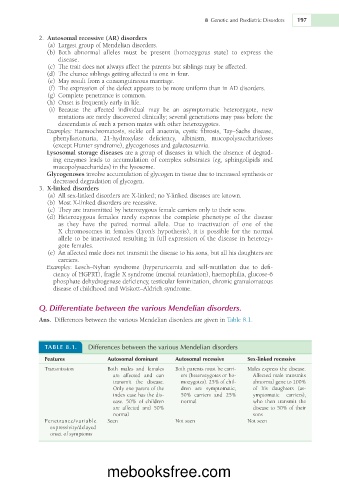
             Q. Differentiate between the various Mendelian disorders.

             Ans.  Differences between the various Mendelian disorders are given in Table 8.1.


               TABLE 8.1.   Differences between the various Mendelian disorders
               Features           Autosomal dominant   Autosomal recessive   Sex-linked recessive
               Transmission       Both  males  and  females   Both parents must be carri-  Males express the disease.
                                    are  affected  and  can   ers (heterozygotes or ho-  Affected male transmits
                                    transmit  the  disease.   mozygotes). 25% of chil-  abnormal gene to 100%
                                    Only one parent of the   dren  are  symptomatic,   of  his  daughters  (as-
                                    index case has the dis-  50%  carriers  and  25%   ymptomatic  carriers),
                                    ease.  50%  of  children   normal          who  then  transmit  the
                                    are  affected  and  50%                    disease to 50% of their
                                    normal                                     sons
               Penetrance/variable     Seen            Not seen              Not seen
                 expressivity/delayed
                 onset of symptoms


                                  mebooksfree.com

