


Page 1665 - Hematology_ Basic Principles and Practice ( PDFDrive )
P. 1665
Chapter 91  Pain Management and Antiemetic Therapy in Hematologic Disorders  1483


                                           Area postrema                 Cognitive                    Other
                                         Neurotransmitters         Conditioned response          Brain edema or tumor
               Drugs                     Dopamine                  (e.g., from chemotherapy)     Adrenal insufficiency
               Digoxin, opioids,         Serotonin                 Memories                      Migraine (D2)
               nicotine, ergot,          Norepinephrine            Sights, sounds, tastes        Pregnancy
               general anesthetics       Enkephalins               Anxiety
               chemotherapy              GABA                      Expectations
               Metabolic disorders       Substance P
               Uremia, DKA,              Receptors
               hypoxemia,                Dopamine (D2)
               hypercalcemia             Serotonin (5-HT3)
               Bacterial toxins          Muscarinic (M1)
               Radiotherapy              Histaminic (H1)               Emetic center
                                         Neurokinin-1 (NK-1)
                                                                         Nucleus                     Emesis
                                                                         Tractus
                                                                         Solitarius
                                                                                                   Gastrointestinal

               Labyrinthine stimuli                                                               Glossopharyngeal
               Motion sickness                   Vestibular nuclei     Vagal afferents             stimulation
               Ménière disease                                        Splanchnic nerves           Gastroparesis
               Tumor             Acetylcholine   Receptors                                        Gastroenteritis
               Infection                         Histamine (H1)                                   GVHD
               Other              Histamine                             5-HT3 R                   Gastritis
               Vection (visual stimuli)                                                           Bowel distention
                                                                                                  Postoperative
                                                                        Serotonin                 Peritoneal
                                                                                                  inflammation
                                                                                                  Vascular occlusion
                                                                                                  Chemotherapy
                                                                                                  Radiotherapy

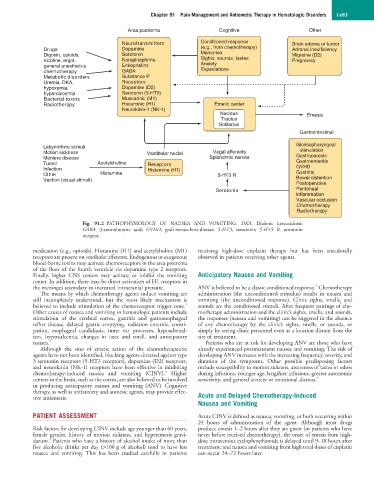
                            Fig.  91.2  PATHOPHYSIOLOGY  OF  NAUSEA  AND  VOMITING.  DKA,  Diabetic  ketoacidosis;
                            GABA,  γ-aminobutyric  acid;  GVHD,  graft-versus-host-disease;  5-HT3,  serotonin;  5-HT3  R,  serotonin
                            receptor.
            medication (e.g., opioids). Histamine (H1) and acetylcholine (M1)   receiving  high-dose  cisplatin  therapy  but  has  been  anecdotally
            receptors are present on vestibular afferents. Endogenous or exogenous   observed in patients receiving other agents.
            blood-borne toxins may activate chemoreceptors in the area postrema
            of the floor of the fourth ventricle via dopamine type 2 receptors.
            Finally,  higher  CNS  centers  may  activate  or  inhibit  the  vomiting   Anticipatory Nausea and Vomiting
            center. In addition, there may be direct activation of H1 receptors in
                                                                                                        9
            the meninges secondary to increased intracranial pressure.  ANV is believed to be a classic conditioned response.  Chemotherapy
              The means by which chemotherapy agents induce vomiting are   administration  (the  unconditioned  stimulus)  results  in  nausea  and
            still  incompletely  understood,  but  the  most  likely  mechanism  is   vomiting  (the  unconditioned  response).  Clinic  sights,  smells,  and
                                                              9
            believed to include stimulation of the chemoreceptor trigger zone.    sounds are the conditioned stimuli. After frequent pairings of che-
            Other causes of nausea and vomiting in hematologic patients include   motherapy administration and the clinic’s sights, smells, and sounds,
            stimulation  of  the  cerebral  cortex,  gastritis  and  gastroesophageal   the responses (nausea and vomiting) can be triggered in the absence
            reflux disease, delayed gastric emptying, radiation enteritis, consti-  of  any  chemotherapy  by  the  clinic’s  sights,  smells,  or  sounds,  or
            pation,  esophageal  candidiasis,  inner  ear  processes,  hypoadrenal-  simply by seeing clinic personnel even at a location distant from the
            ism,  hypercalcemia,  changes  in  taste  and  smell,  and  anticipatory     site of treatment.
            nausea. 9                                               Patients who are at risk for developing ANV are those who have
              Although  the  sites  of  emetic  action  of  the  chemotherapeutic   already experienced posttreatment nausea and vomiting. The risk of
            agents have not been identified, blocking agents directed against type   developing ANV increases with the increasing frequency, severity, and
            3 serotonin receptors (5-HT3 receptors), dopamine (D2) receptors,   duration  of  the  symptoms.  Other  possible  predisposing  factors
            and neurokinin (NK-1) receptors have been effective in inhibiting   include susceptibility to motion sickness, awareness of tastes or odors
                                                       9
            chemotherapy-induced  nausea  and  vomiting  (CINV).   Higher   during infusions, younger age, lengthier infusions, greater autonomic
            centers in the brain, such as the cortex, are also believed to be involved   sensitivity, and general anxiety or emotional distress. 9
            in  producing  anticipatory  nausea  and  vomiting  (ANV).  Cognitive
            therapy, as well as antianxiety and amnesic agents, may provide effec-
            tive antiemesis.                                      Acute and Delayed Chemotherapy-Induced
                                                                  Nausea and Vomiting

            PATIENT ASSESSMENT                                    Acute CINV is defined as nausea, vomiting, or both occurring within
                                                                  24  hours  of  administration  of  the  agent.  Although  most  drugs
            Risk factors for developing CINV include age younger than 60 years,   produce emesis 1–2 hours after they are given (in patients who have
            female  gender,  history  of  motion  sickness,  and  hyperemesis  gravi-  never before received chemotherapy), the onset of emesis from high-
                 9
            darum.  Patients who have a history of alcohol intake of more than   dose intravenous cyclophosphamide is delayed until 9–18 hours after
            five alcoholic drinks per day (>100 g of alcohol) tend to have less   treatment, and nausea and vomiting from high total doses of cisplatin
            nausea  and  vomiting.  This  has  been  studied  carefully  in  patients   can occur 24–72 hours later.

