


Page 2497 - Hematology_ Basic Principles and Practice ( PDFDrive )
P. 2497
Chapter 152  Hematologic Manifestations of Childhood Illness  2229


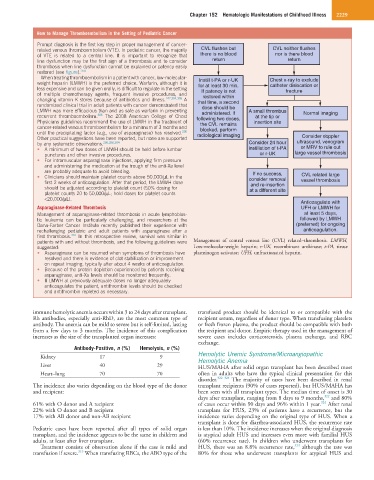
             How to Manage Thromboembolism in the Setting of Pediatric Cancer
             Prompt diagnosis is the first key step in proper management of cancer-
             related venous thromboembolism (VTE). In pediatric cancer, the majority   CVL flushes but  CVL neither flushes
             of  VTE  is  related  to  a  central  line.  It  is  important  to  recognize  that   there is no blood  nor is there blood
             line dysfunction may be the first sign of a thrombosis and to consider   return   return
             thrombosis when line dysfunction cannot be explained or patency easily
             restored (see figure). 254
              When treating thromboembolism in a patient with cancer, low-molecular-  Instill t-PA or r-UK  Chest x-ray to exclude
             weight heparin (LMWH) is the preferred choice. Warfarin, although it is   for at least 30 min.  catheter dislocation or
             less expensive and can be given orally, is difficult to regulate in the setting   If patency is not  fracture
             of  multiple  chemotherapy  agents,  frequent  invasive  procedures,  and   restored within
             changing vitamin K stores because of antibiotics and illness. 247,304,305  A   that time, a second
             randomized clinical trial in adult patients with cancer demonstrated that   dose should be
             LMWH was more efficacious than and as safe as warfarin in preventing   administered. If  A small thrombus  Normal imaging
             recurrent  thromboembolism. 306   The  2008  American  College  of  Chest   following two doses,  at the tip or
             Physicians guidelines recommend the use of LMWH in the treatment of   the CVL remains  insertion site
             cancer-related venous thromboembolism for a minimum of 3 months and   blocked, perform
             until the precipitating factor (e.g., use of asparaginase) has resolved. 286    radiological imaging
             Other practical suggestions have been reported, but none are supported                 Consider doppler
             by any systematic observations. 260,286,304                          Consider 24 hour  ultrasound, venogram
             •  A minimum of two doses of LMWH should be held before lumbar       instillation of t-PA  or MRV to rule out
                punctures and other invasive procedures.                              or r-UK    large vessel thrombosis
             •  For intramuscular asparaginase injections, applying firm pressure
                and administering the medication at the trough of the anti-Xa level
                are probably adequate to avoid bleeding.                            If no success,
             •  Clinicians should maintain platelet counts above 50,000/µL in the   consider removal  CVL related large
                first 2 weeks of anticoagulation. After that period, the LMWH dose   and re-insertion  vessel thrombosis
                should be adjusted according to platelet count (50% dosing for     at a different site
                platelet counts 20 to 50,000/µL; hold doses for platelet counts
                <20,000/µL).
                                                                                                   Anticoagulate with
             Asparaginase-Related Thrombosis                                                       UFH or LMWH for
             Management  of asparaginase-related thrombosis in acute lymphoblas-                     at least 5 days,
             tic  leukemia  can  be  particularly  challenging,  and  researchers  at  the         followed by LMWH
             Dana-Farber  Cancer  Institute  recently  published  their  experience  with         (preferred) for ongoing
             rechallenging  pediatric  and  adult  patients  with  asparaginase  after  a           anticoagulation.
             first  thrombosis. 307   In  this  retrospective  review,  survival  was  similar  in
             patients with and without thrombosis, and the following guidelines were   Management  of  central  venous  line  (CVL)  related–thrombosis.  LMWH,
             suggested:                                         Low-molecular-weight  heparin;  r-UK,  recombinant  urokinase;  t-PA,  tissue
             •  Asparaginase can be resumed when symptoms of thrombosis have   plasminogen activator; UFH, unfractionated heparin.
                resolved and there is evidence of clot stabilization or improvement
                on repeat imaging, typically after about 4 weeks of anticoagulation.
             •  Because of the protein depletion experienced by patients receiving
                asparaginase, anti-Xa levels should be monitored frequently.
             •  If LMWH at previously adequate doses no longer adequately
                anticoagulates the patient, antithrombin levels should be checked
                and antithrombin repleted as necessary.


            immune hemolytic anemia occurs within 3 to 24 days after transplant.   transfused  product  should  be  identical  to  or  compatible  with  the
            Rh antibodies, especially anti-RhD, are the most common type of   recipient serum, regardless of donor type. When transfusing platelets
            antibody. The anemia can be mild to severe but is self-limited, lasting   or fresh frozen plasma, the product should be compatible with both
            from a few days to 3 months. The incidence of this complication   the recipient and donor. Empiric therapy used in the management of
            increases as the size of the transplanted organ increases:  severe  cases  includes  corticosteroids,  plasma  exchange,  and  RBC
                                                                  exchange.
                         Antibody-Positive, n (%)  Hemolysis, n (%)
              Kidney              17                 9            Hemolytic Uremic Syndrome/Microangiopathic
                                                                  Hemolytic Anemia
              Liver               40                29            HUS/MAHA after solid organ transplant has been described most
              Heart–lung          70                70            often  in  adults  who  have  the  typical  clinical  presentation  for  this
                                                                  disorder. 322–324  The  majority  of  cases  have  been  described  in  renal
            The incidence also varies depending on the blood type of the donor   transplant recipients (90% of cases reported), but HUS/MAHA has
            and recipient:                                        been seen with all transplant types. The median time of onset is 30
                                                                                                           322
                                                                  days after transplant, ranging from 8 days to 9 months,  and 80%
                                                                                                          324
            61% with O donor and A recipient                      of cases occur within 90 days and 96% within 1 year.  After renal
            22% with O donor and B recipient                      transplant  for  HUS,  23%  of  patients  have  a  recurrence,  but  the
            17% with AB donor and non-AB recipient                incidence varies depending on the original type of HUS. When a
                                                                  transplant is done for diarrhea-associated HUS, the recurrence rate
            Pediatric  cases  have  been  reported  after  all  types  of  solid  organ   is less than 10%. The incidence increases when the original diagnosis
            transplant, and the incidence appears to be the same in children and   is atypical adult HUS and increases even more with familial HUS
            adults, at least after liver transplant.              (60% recurrence rate). In children who underwent transplants for
                                                                                                 323
              Treatment consists of observation alone if the case is mild and   HUS, there was an 8.8% recurrence rate,  although the rate was
                           319
            transfusion if severe.  When transfusing RBCs, the ABO type of the   80%  for  those  who  underwent  transplants  for  atypical  HUS  and

