


Page 2526 - Hematology_ Basic Principles and Practice ( PDFDrive )
P. 2526
Chapter 155  Hematologic Manifestations of Malignancy  2249


            contribute  to  tumor  progression.  Platelets  derived  from  cancer   white blood cell counts, low body mass index/BSA, advanced disease,
            patients  are  in  an  activated  state,  with  increased  surface  P-selectin   and the use of myelosuppressive chemotherapy agents. General treat-
            expression  and  elevated  serum  levels  of  platelet  factor  IV  and   ment principles for neutropenic fever include the consideration of
            β-thromboglobulin. Activated platelets may contribute to the throm-  prophylactic antibiotics or myeloid growth factor support, such as
            bophilic state in cancer patients, and also interact with leukocytes,   granulocyte  colony-stimulating  factor  (G-CSF).  Consideration
            endothelial cells, and tumor cells, all of which may contribute to the   should be given to the elevated risk of FN associated with specific
            early stages of tumor cell dissemination. A number of platelet recep-  chemotherapeutic agents, including situations where dose-dense or
            tors may contribute to the platelet support of metastasis, including   intense chemotherapy regimens provide survival benefit. Depending
            glycoprotein (GP) IIb/IIIa, adenosine diphosphate (ADP) receptors,   on the regimen and disease, prophylactic G-CSF should be consid-
            P-selectin and thrombin receptors, and others, with likely multiple   ered, particularly when there is a greater than 20% overall risk of FN;
            mechanisms underlying the platelet effects on malignancy. Platelets   once a patient develops FN, G-CSF is typically reserved for situations
            stabilize otherwise short-lived tumor cells in the circulation. Platelet–  where they are not responding to appropriate treatment and develop
            tumor cell interaction enhances tumor cell adhesion to the vessel wall,   life-threatening conditions.
            and appears to alter vessel wall permeability, and in this way may   Several  tumors  express  G-CSF  receptors;  there  is  a  theoretic
            facilitate  tumor  cell  invasion.  Platelets  protect  tumor  cells  from   concern that exogenous G-CSF may increase proliferation of these
            immune surveillance and destruction, in part by shielding tumor cells   tumors. In addition, the use of myeloid growth factors during che-
            from  natural  killer  cells,  although  other  mechanisms  are  likely.   motherapy for solid tumors has been theorized to increase the risk of
            Platelets provide nutrient support (growth factors) and release pro-  subsequent  myeloid  malignancy  by  acting  as  a  survival  signal  to
            angiogenic factors. Platelets contain numerous growth factors, coagu-  hematopoietic progenitor cells damaged by chemotherapy. A meta-
            lation  factors  and  adhesive  molecules,  chemokines,  and  bioactive   analysis  of  25  randomized  clinical  trials  found  that  there  was  an
            lipids that may enhance metastatic efficiency. Platelets are enriched   almost twofold increase in acute myeloid leukemia in those patients
            in angiogenic growth factors such as basic fibroblast growth factor   assigned to receive chemotherapy with growth factor support, com-
            and VEGF, as well as other mediators, and may regulate angiogenesis.   pared with those who did not receive growth factor support, although
            Selective P-selectin and thrombin receptor activation on platelets may   the absolute rates of secondary leukemia were low in each group.
            release α-granules enriched in either VEGF or endostatin. Platelet-  An important consideration during chemotherapy is to recognize
            derived transforming growth factor-β and direct platelet–tumor cell   that benign neutropenia related to certain ethnicities, particularly in
            interactions  promote  epithelial  mesenchymal  transformation  and   those of African and Middle Eastern descent, may be a contributing
            tumor metastases.                                     factor and does not require dose-adjustment of chemotherapy.


            LEUKOCYTES                                            BONE MARROW METASTASES
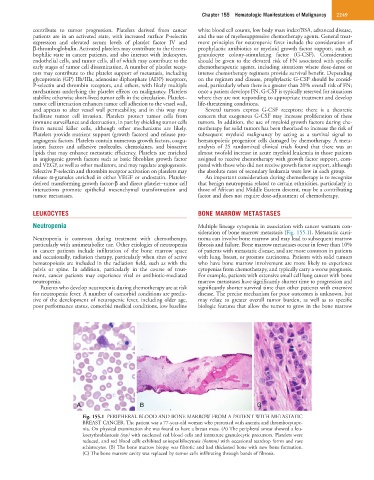
            Neutropenia                                           Multiple lineage cytopenia in association with cancer warrants con-
                                                                  sideration of bone marrow metastasis (Fig. 155.1). Metastatic carci-
            Neutropenia  is  common  during  treatment  with  chemotherapy,   noma can involve bone marrow and may lead to subsequent marrow
            particularly with antimetabolite use. Other etiologies of neutropenia   fibrosis and failure. Bone marrow metastases occur in fewer than 10%
            in  cancer  patients  include  infiltration  of  the  bone  marrow  space   of patients with metastatic disease, and are more common in patients
            and occasionally, radiation therapy, particularly when sites of active   with lung, breast, or prostate carcinoma. Patients with solid tumors
            hematopoiesis are included in the radiation field, such as with the   who have bone marrow involvement are more likely to experience
            pelvis  or  spine.  In  addition,  particularly  in  the  course  of  treat-  cytopenias from chemotherapy, and typically carry a worse prognosis.
            ment,  cancer  patients  may  experience  viral  or  antibiotic-mediated     For example, patients with extensive small cell lung cancer with bone
            neutropenia.                                          marrow metastases have significantly shorter time to progression and
              Patients who develop neutropenia during chemotherapy are at risk   significantly shorter survival time than other patients with extensive
            for neutropenic fever. A number of comorbid conditions are predic-  disease. The precise mechanism for poor outcomes is unknown, but
            tive of the development of neutropenic fever, including older age,   may  relate  to  greater  overall  tumor  burden,  as  well  as  to  specific
            poor performance status, comorbid medical conditions, low baseline   biologic features that allow the tumor to grow in the bone marrow


                          A                    B                                     C
                            Fig. 155.1  PERIPHERAL BLOOD AND BONE MARROW FROM A PATIENT WITH METASTATIC
                            BREAST CANCER. The patient was a 77-year-old woman who presented with anemia and thrombocytope-
                            nia. On physical examination she was found to have a breast mass. (A) The peripheral smear showed a leu-
                            koerythroblastosis (top) with nucleated red blood cells and immature granulocytic precursors. Platelets were
                            reduced, and red blood cells exhibited anisopoikilocytosis (bottom) with occasional teardrop forms and rare
                            schistocytes. (B) The bone marrow biopsy was fibrotic and had thickened bone with new bone formation.
                            (C) The bone marrow cavity was replaced by tumor cells infiltrating through bands of fibrosis.

