


Page 1139 - Williams Hematology ( PDFDrive )
P. 1139
1114           Part VIII:  Monocytes and Macrophages                                                                                                              Chapter 71:  Inflammatory and Malignant Histiocytosis          1115


               Perforin Expression                                     TABLE 71–4.  Clinical Criteria for Diagnosis of
               Perforin was identified as a candidate HLH gene by gene mapping and   Hemophagocytic Lymphohistiocytosis
               was confirmed by poor expression of perforin in NK cells and cytotoxic
               T lymphocytes of HLH patients. 223,224  Some HLH characteristics were   Hemophagocytic lymphohistiocytosis (HLH) diagnosis is estab-
               reproducible in PRF1 knockout mice.  Perforin is secreted from NK   lished with at least five of the following:
                                           225
               cells and cytotoxic T cells upon activation by target cells and introduces   •  Fever
               pores in the target cell membrane, allowing granzyme to enter and trig-  •  Splenomegaly
               ger apoptosis. 226                                      •  Cytopenias in at least two cell lines:

               Other Defects Causing Hemophagocytic Lymphohistiocytosis  •  Hemoglobin <90 g/L
                                                                                      9
               Mutations in other genes encoding proteins involved in NK and cyto-  Platelets <100 × 10 /L
                                                                                       9
               toxic T-cell–mediated killing of target cells also have been discovered in   Neutrophils <1 × 10 /L
               patients with HLH, including UNC13D (encodes MUNC13-4), STX11   •  Hypertriglyceridemia and/or hypofibrinogenemia:
               (encodes syntaxin 11), and UNC18B (encodes STXBP2).  Mutations   Fasting triglycerides >3 mmol/L (>265 mg/dL)
                                                         227
               in the gene that encodes RAB27a (protein that controls secretion
               of lytic granules) have also been identified in patients with Griscelli   Fibrinogen <1.5 g/L
               syndrome. 228                                           •  Hemophagocytosis in marrow or spleen or lymph nodes
                                                                       •   Low or absent activity of natural killer cells (specialized laboratory
               Immune Deficiencies Associated with Hemophagocytic       test)
               Lymphohistiocytosis                                     •  Ferritin >500 mcg/L (>2000 mcg/L may be more specific)
               Patients with other immune deficiencies associated with lysosomal   •  Soluble cD25 (soluble interleukin-2 receptor) >2400 U/mL
               trafficking defects (e.g., Chédiak-Higashi syndrome, Hermansky-   or
               Pudlak syndrome type II) also have a high frequency of HLH.  HLH,   •  HLH-associated gene mutations
                                                            229
               often associated with infection by the Epstein-Barr virus, is the most
               common fatal complication of X-linked lymphoproliferative disease
               (XLP1/SH2D1A and XLP2/XIAP). 230
                                                                      cytometry degranulation assays that measure membrane CD107a are
                                                                      also effective for identifying patients with lymphocytes with impaired
               CLINICAL FEATURES                                      cytotoxic function. 236
                                                                          Hemophagocytosis is sometimes misunderstood as pathogno-
               Initial signs  and symptoms  of HLH mimic  more common  problems   monic and necessary for the diagnosis of HLH, but biopsies fail to
               (e.g., fever of unknown origin or sepsis).  Confounding diagnoses   demonstrate hemophagocytosis in approximately one-third of patients
                                               231
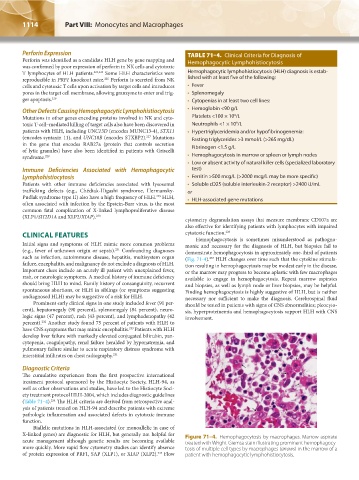
               such as infection, autoimmune disease, hepatitis, multisystem organ   (Fig. 71-4).  HLH changes over time such that the cytokine stimula-
                                                                              237
               failure, encephalitis, and malignancy do not exclude a diagnosis of HLH.   tion resulting in hemophagocytosis may be modest early in the disease,
               Important clues include an acutely ill patient with unexplained fever,   or the marrow may progress to become aplastic with few macrophages
               rash, or neurologic symptoms. A medical history of immune deficiency   available to engage in hemophagocytosis. Repeat marrow aspirates
               should bring HLH to mind. Family history of consanguinity, recurrent   and biopsies, as well as lymph node or liver biopsies, may be helpful.
               spontaneous abortions, or HLH in siblings (or symptoms suggesting   Finding hemophagocytosis is highly suggestive of HLH, but is neither
               undiagnosed HLH) may be suggestive of a risk for HLH.  necessary  nor  sufficient  to  make  the  diagnosis.  Cerebrospinal  fluid
                   Prominent early clinical signs in one study included fever (91 per-  should be tested in patients with signs of CNS abnormalities; pleocyto-
               cent), hepatomegaly (90 percent), splenomegaly (84 percent), neuro-  sis, hyperproteinemia and hemophagocytosis support HLH with CNS
               logic signs (47 percent), rash (43 percent), and lymphadenopathy (42   involvement.
               percent).  Another study found 75 percent of patients with HLH to
                      232
               have CNS symptoms that may mimic encephalitis.  Patients with HLH
                                                   233
               develop liver failure with markedly elevated conjugated bilirubin, pan-
               cytopenia, coagulopathy, renal failure heralded by hyponatremia, and
               pulmonary failure similar to acute respiratory distress syndrome with
               interstitial infiltrates on chest radiography. 231

               Diagnostic Criteria
               The cumulative experiences from the first prospective international
               treatment protocol sponsored by the Histiocyte Society, HLH-94, as
               well as other observations and studies, have led to the Histiocyte Soci-
               ety treatment protocol HLH-2004, which includes diagnostic guidelines
               (Table 71–4).  The HLH criteria are derived from retrospective anal-
                         234
               ysis of patients treated on HLH-94 and describe patients with extreme
               pathologic inflammation and associated defects in cytotoxic immune
               function.
                   Biallelic mutations in HLH-associated (or monoallelic in case of
               X-linked genes) are diagnostic for HLH, but generally not helpful for   Figure 71–4.  Hemophagocytosis by macrophages. Marrow aspirate
               acute  management  although  genetic  results  are  becoming available   treated with Wright-Giemsa stain illustrating prominent hemophagocy-
               more quickly. More rapid flow cytometry studies can identify absence   tosis of multiple cell types by macrophages (arrows) in the marrow of a
               of protein expression of PRF1, SAP (XLP1), or XIAP (XLP2).  Flow   patient with hemophagocytic lymphohistiocytosis.
                                                             235


          Kaushansky_chapter 71_p1101-1120.indd   1114                                                                  9/17/15   3:51 PM

