


Page 1420 - Williams Hematology ( PDFDrive )
P. 1420
1394  Part X:  Malignant Myeloid Diseases                        Chapter 88:  Acute Myelogenous Leukemia             1395


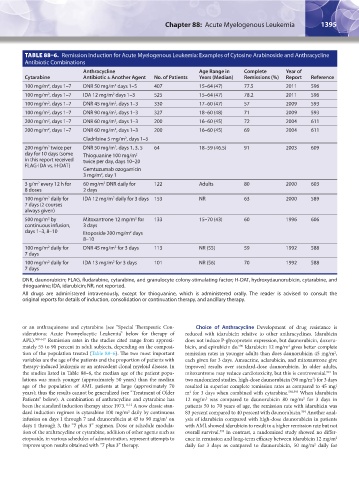
                   TABLE 88–6.  Remission Induction for Acute Myelogenous Leukemia: Examples of Cytosine Arabinoside and Anthracycline
                   Antibiotic Combinations
                                      Anthracycline                          Age Range in   Complete      Year of
                   Cytarabine         Antibiotic ± Another Agent  No. of Patients  Years (Median)  Remissions (%)  Report  Reference
                   100 mg/m , days 1–7  DNR 50 mg/m  days 1–5  407           15–64 (47)     77.5          2011     596
                                                 2
                          2
                   100 mg/m , days 1–7  IDA 12 mg/m  days 1–3  525           15–64 (47)     78.2          2011     596
                          2
                                                2
                   100 mg/m , days 1–7  DNR 45 mg/m , days 1–3  330          17–60 (47)     57            2009     593
                                                 2
                          2
                   100 mg/m , days 1–7  DNR 90 mg/m , days 1–3  327          18–60 (48)     71            2009     593
                          2
                                                 2
                   200 mg/m , days 1–7  DNR 60 mg/m , days 1–3  200          16–60 (45)     72            2004     611
                          2
                                                 2
                   200 mg/m , days 1–7  DNR 60 mg/m , days 1–3  200          16–60 (45)     69            2004     611
                                                 2
                          2
                                      Cladribine 5 mg/m , days 1–5
                                                    2
                                                 2
                   200 mg/m  twice per   DNR 50 mg/m , days 1, 3, 5  64      18–59 (46.5)   91            2003     609
                          2
                   day for 10 days (some   Thioguanine 100 mg/m
                                                        2
                   in this report received   twice per day, days 10–20
                   FLAG-IDA vs. H-DAT)
                                      Gemtuzumab ozogamicin
                                            2
                                      3 mg/m , day 1
                   3 g/m  every 12 h for    60 mg/m  DNR daily for    122    Adults         80            2000     603
                                             2
                       2
                   8 doses            2 days
                   100 mg/m  daily for    IDA 12 mg/m  daily for 3 days 153  NR             63            2000     589
                          2
                                                2
                   7 days (2 courses
                   always given)
                   500 mg/m  by       Mitoxantrone 12 mg/m  for   133        15–70 (43)     60            1996     606
                          2
                                                        2
                   continuous infusion,   3 days
                   days 1–3, 8–10     Etoposide 200 mg/m  days
                                                      2
                                      8–10
                                                 2
                   100 mg/m  daily for    DNR 45 mg/m  for 3 days  113       NR (55)        59            1992     588
                          2
                   7 days
                   100 mg/m  daily for    IDA 13 mg/m  for 3 days  101       NR (56)        70            1992     588
                          2
                                                2
                   7 days
                  DNR, daunorubicin; FLAG, fludarabine, cytarabine, and granulocyte colony-stimulating factor; H-DAT, hydroxydaunorubicin, cytarabine, and
                  thioguanine; IDA, idarubicin; NR, not reported.
                  All  drugs  are  administered  intravenously,  except  for  thioguanine,  which  is  administered  orally.  The  reader  is  advised  to  consult  the
                  original reports for details of induction, consolidation or continuation therapy, and ancillary therapy.
                  or an anthraquinone and cytarabine (see “Special Therapeutic Con-  Choice of Anthracycline  Development  of  drug  resistance  is
                  siderations: Acute Promyelocytic  Leukemia”  below  for therapy  of   reduced with idarubicin relative to other anthracyclines. Idarubicin
                  APL). 588–617   Remission  rates  in  the  studies  cited  range  from  approxi-  does not induce P-glycoprotein expression, but daunorubicin, doxoru-
                  mately 55 to 90 percent in adult subjects, depending on the composi-  bicin, and epirubicin do.  Idarubicin 12 mg/m  gives better complete
                                                                                                           2
                                                                                          590
                  tion of the population treated (Table 88–6). The two most important     remission rates in younger adults than does daunorubicin 45 mg/m ,
                                                                                                                          2
                  variables are the age of the patients and the proportion of patients with   each given for 3 days. Amsacrine, aclarubicin, and mitoxantrone give
                  therapy-induced leukemia or an antecedent clonal myeloid disease. In   improved results over standard-dose daunorubicin. In older adults,
                  the studies listed in Table  88–6, the median age of the patient popu-  mitoxantrone may reduce cardiotoxicity, but this is controversial.  In
                                                                                                                        591
                  lations was much younger (approximately 50 years) than the median   two randomized studies, high-dose daunorubicin (90 mg/m ) for 3 days
                                                                                                                   2
                  age  of  the population of  AML patients at  large (approximately 70   resulted in superior complete remission rates as compared to 45 mg/
                  years); thus the results cannot be generalized (see “Treatment of Older   m  for 3 days when combined with cytarabine. 592,593  When idarubicin
                                                                          2
                  Patients” below). A combination of anthracycline and cytarabine has   12 mg/m  was compared to daunorubicin 80 mg/m  for 3 days in
                                                                                                                2
                                                                               2
                  been the standard induction therapy since 1973. 11,12  A now classic stan-  patients 50 to 70 years of age, the remission rate with idarubicin was
                  dard induction regimen is cytarabine 100 mg/m  daily by continuous   83 percent compared to 40 percent with daunorubicin.  Another anal-
                                                                                                               594
                                                     2
                  infusion on days 1 through 7 and daunorubicin at 45 to 90 mg/m  on   ysis of idarubicin compared with high-dose daunorubicin in patients
                                                                  2
                  days 1 through 3, the “7 plus 3” regimen. Dose or schedule modula-  with AML showed idarubicin to result in a higher remission rate but not
                  tion of the anthracycline or cytarabine, addition of other agents such as   overall survival.  In contrast, a randomized study showed no differ-
                                                                                    595
                  etoposide, in various schedules of administration, represent attempts to   ence in remission and long-term efficacy between idarubicin 12 mg/m
                                                                                                                           2
                  improve upon results obtained with “7 plus 3” therapy.  daily for 3 days as compared to daunorubicin, 50 mg/m  daily for
                                                                                                                    2
          Kaushansky_chapter 88_p1373-1436.indd   1395                                                                  9/21/15   11:01 AM

