


Page 1735 - Williams Hematology ( PDFDrive )
P. 1735
1710           Part XI:  Malignant Lymphoid Diseases                                                                                                       Chapter 105:  Plasma Cell Neoplasms: General Considerations           1711


               the phosphorylated forms of Paratarg-7 were studied, they were found   are not the only driving force in the development of PCN. Although
               to have a 6.5-fold higher risk of developing IgM monoclonal gammopa-  ethnicity and genealogy affect the prevalence of monoclonal gammo-
               thy or macroglobulinemia. The antigen causes continuous autostimula-  pathy,  they do not impact the rate of progression from monoclonal
                                                                          76
               tion of cognate T-helper cells, which, in turn, specifically activate B cells   gammopathy to myeloma. Furthermore, there is a higher incidence in
               with high affinity to Paratarg-7.                      monoclonal gammopathy in relatives of myeloma patients than seen in
                                                                      the general public. 77,78  These results demonstrate that not only are there
                                                                      somatic mutations important to the development of PCNs, but genetic
                    GENETIC ABNORMALITIES IN PLASMA                   background also contributes to the likelihood of the development of
                  CELL NEOPLASM                                       plasma cell diseases.
               MYELOMA                                                Late Events in Myeloma Progression
                                                                      Much focus has been placed on risk factors and early genetic events
               Plasma cell differentiation begins in lymph nodes and in the spleen   that can be used as diagnostic and prognostic markers. However, we
               where cells undergo changes in gene expression and cell-surface mole-  are learning more about the genetic alterations that occur throughout
               cules followed by migration to the marrow or mucosal lamina proper.    disease progression. One of the more prominent discoveries focuses on
                                                                 65
               The development of plasma cells alters the cellular receptor landscape   the activation of NF-κB. Approximately 50 percent of myeloma patients
               of  the  cell  with  the  deletion of  important  B-cell  receptors  and  the   exhibit canonical NF-κB activation. 79,80  NF-κB functions, in part, by reg-
               addition of receptors necessary for plasma cell function and antibody   ulating growth and survival within the myeloma cells; overexpression
               production. Changes to cellular receptors include downregulation of   of positive regulators, such as NIK, NFKB1, NFKB2, and CD40, and
               major histocompatibility complex (MHC) class II, CD19, CD21, and   inactivation of negative regulators, such as CLYD, TRAF2, TRAF3, and
               CD22.  Perhaps, the most important alterations during myeloma   cIAP1/cIAP2, contribute to the constitutive activation of NF-κB within
                    66
               development are decreases of the B-cell receptor (BCR), CXCR5, and   these cells. 80
               CCR7. In contrast, plasma cells upregulate CXCR4, CD138, and CD38     RAS mutations are also important contributors to the development
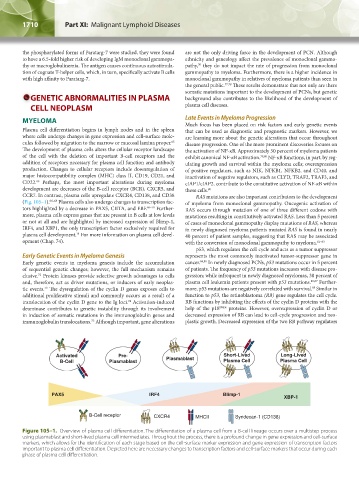
               (Fig. 105–1). 66–68  Plasma cells also undergo changes to transcription fac-  of myeloma from monoclonal gammopathy. Oncogenic activation of
               tors highlighted by a decrease in PAX5, CIITA, and EBF. 66–70  Further-  RAS occurs through mutation of one of three different codons with
               more, plasma cells express genes that are present in B cells at low levels   mutations resulting in constitutively activated RAS. Less than 5 percent
               or not at all and are highlighted by increased expression of Blimp-1,   of cases of monoclonal gammopathy display mutations of RAS, whereas
               IRF4, and XBP1, the only transcription factor exclusively required for   in newly diagnosed myeloma patients mutated RAS is found in nearly
               plasma cell development.  For more information on plasma cell devel-  40 percent of patient samples, suggesting that RAS may be associated
                                  71
               opment (Chap. 74).                                     with the conversion of monoclonal gammopathy to myeloma. 81–83
                                                                          p53, which regulates the cell cycle and acts as a tumor suppressor
               Early Genetic Events in Myeloma Genesis                represents the most commonly inactivated tumor-suppressor gene in
               Early genetic events in myeloma genesis include the accumulation   cancer. 84,85  In newly diagnosed PCNs, p53 mutations occur in 5 percent
               of sequential genetic changes; however, the full mechanism remains   of patients. The frequency of p53 mutations increases with disease pro-
               elusive.  Protein kinases provide selective growth advantages to cells   gression; while infrequent in newly diagnosed myelomas, 30 percent of
                     72
               and, therefore, act as driver mutations, or inducers of early neoplas-  plasma cell leukemia patients present with p53 mutations. 86,87  Further-
               tic events.  The dysregulation of the cyclin D genes exposes cells to   more, p53 mutations are negatively correlated with survival.  Similar in
                                                                                                                 88
                       73
               additional proliferative stimuli and commonly occurs as a result of a   function to p53, the retinoblastoma (RB) gene regulates the cell cycle.
               translocation of the cyclin D gene to the Ig loci.  Activation-induced   RB functions by inhibiting the effects of the cyclin D proteins with the
                                                   74
               deaminase contributes to genetic instability through its involvement   help of the  p18 INK4  proteins. However,  overexpression  of cyclin  D  or
               in induction of somatic mutations in the immunoglobulin genes and   decreased expression of RB can lead to cell-cycle progression and neo-
               immunoglobulin translocations.  Although important, gene alterations   plastic growth. Decreased expression of the two RB pathway regulators
                                       75


                           Activated            Pre-            Plasmablast        Short-Lived        Long-Lived
                            B-Cell          Plasmablast                            Plasma Cell        Plasma Cell


                         PAX5                             IRF4                     Blimp-1
                                                                                                       XBP-1


                                      B-Cell receptor      CXCR4         MHCII         Syndecan-1 (CD138)

               Figure 105–1.  Overview of plasma cell differentiation. The differentiation of a plasma cell from a B-cell lineage occurs over a multistep process
               using plasmablast and short-lived plasma cell intermediates. Throughout the process, there is a profound change in gene expression and cell-surface
               markers, which allows for the identification of each stage based on the cell-surface marker expression and gene expression of transcription factors
               important to plasma cell differentiation. Depicted here are necessary changes to transcription factors and cell-surface markers that occur during each
               phase of plasma cell differentiation.


          Kaushansky_chapter 105_p1707-1720.indd   1710                                                                 9/18/15   9:44 AM

