


Page 2099 - Williams Hematology ( PDFDrive )
P. 2099
2074           Part XII:  Hemostasis and Thrombosis                                                                                                                Chapter 121:  Acquired Qualitative Platelet Disorders         2075


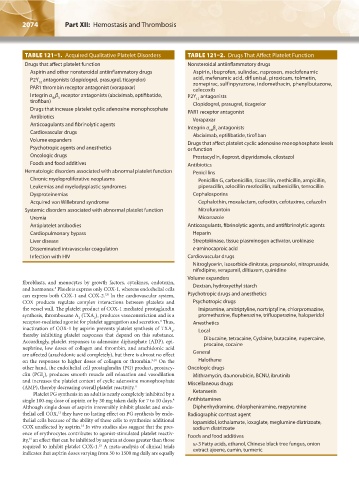
                TABLE 121–1.  Acquired Qualitative Platelet Disorders  TABLE 121–2.  Drugs That Affect Platelet Function
                Drugs that affect platelet function                    Nonsteroidal antiinflammatory drugs
                  Aspirin and other nonsteroidal antiinflammatory drugs     Aspirin, ibuprofen, sulindac, naproxen, meclofenamic
                  P2Y  antagonists (clopidogrel, prasugrel, ticagrelor)  acid, mefenamic acid, diflunisal, piroxicam, tolmetin,
                     12                                                  zomepirac, sulfinpyrazone, indomethacin, phenylbutazone,
                  PAR1 thrombin receptor antagonist (vorapaxar)          celecoxib
                   Integrin α β  receptor antagonists (abciximab, eptifibatide,   P2Y  antagonists
                         IIb 3
                                                                          12
                  tirofiban)                                             Clopidogrel, prasugrel, ticagrelor
                  Drugs that increase platelet cyclic adenosine monophosphate  PAR1 receptor antagonist
                  Antibiotics                                            Vorapaxar
                  Anticoagulants and fibrinolytic agents               Integrin α β  antagonists
                                                                              IIb 3
                  Cardiovascular drugs                                   Abciximab, eptifibatide, tirofiban
                  Volume expanders                                     Drugs that affect platelet cyclic adenosine monophosphate levels
                  Psychotropic agents and anesthetics                  or function
                  Oncologic drugs                                        Prostacyclin, iloprost, dipyridamole, cilostazol
                  Foods and food additives                             Antibiotics
                Hematologic disorders associated with abnormal platelet function    Penicillins
                  Chronic myeloproliferative neoplasms                      Penicillin G, carbenicillin, ticarcillin, methicillin, ampicillin,

                  Leukemias and myelodysplastic syndromes                 piperacillin, azlocillin mezlocillin, sulbenicillin, temocillin
                  Dysproteinemias                                        Cephalosporins
                  Acquired von Willebrand syndrome                         Cephalothin, moxalactam, cefoxitin, cefotaxime, cefazolin
                Systemic disorders associated with abnormal platelet function     Nitrofurantoin
                  Uremia                                                  Miconazole
                  Antiplatelet antibodies                              Anticoagulants, fibrinolytic agents, and antifibrinolytic agents
                  Cardiopulmonary bypass                                 Heparin
                  Liver disease                                          Streptokinase, tissue plasminogen activator, urokinase
                  Disseminated intravascular coagulation                 ε-aminocaproic acid
                  Infection with HIV                                   Cardiovascular drugs
                                                                          Nitroglycerin, isosorbide dinitrate, propranolol, nitroprusside,
                                                                         nifedipine, verapamil, diltiazem, quinidine
                                                                       Volume expanders
               fibroblasts, and monocytes by growth factors, cytokines, endotoxin,
               and hormones.  Platelets express only COX-1, whereas endothelial cells     Dextran, hydroxyethyl starch
                          5
               can express both COX-1 and COX-2.  In the cardiovascular system,   Psychotropic drugs and anesthetics
                                           7,8
               COX products regulate complex interactions between platelets and     Psychotropic drugs
               the vessel wall. The platelet product of COX-1 mediated prostaglandin        Imipramine, amitriptyline, nortriptyline, chlorpromazine,
               synthesis, thromboxane A  (TXA ), produces vasoconstriction and is a   promethazine, fluphenazine, trifluoperazine, haloperidol
                                       2
                                  2
               receptor-mediated agonist for platelet aggregation and secretion.  Thus,     Anesthetics
                                                              4
               inactivation of COX-1 by aspirin prevents platelet synthesis of TXA ,      Local
                                                                 2
               thereby  inhibiting  platelet  responses  that  depend  on  this  substance.
               Accordingly, platelet responses to adenosine diphosphate (ADP), epi-         Dibucaine, tetracaine, Cyclaine, butacaine, nupercaine,
                                                                            procaine, cocaine
               nephrine, low doses of collagen and thrombin, and arachidonic acid
               are affected (arachidonic acid completely), but there is almost no effect     General
               on the responses to higher doses of collagen or thrombin.  On the      Halothane
                                                           9,10
               other hand, the endothelial cell prostaglandin (PG) product, prostacy-  Oncologic drugs
               clin (PGI ), produces smooth muscle cell relaxation and vasodilation     Mithramycin, daunorubicin, BCNU, ibrutinib
                      2
               and increases the platelet content of cyclic adenosine monophosphate   Miscellaneous drugs
               (AMP), thereby decreasing overall platelet reactivity. 11
                   Platelet PG synthesis in an adult is nearly completely inhibited by a     Ketanserin
               single 100-mg dose of aspirin or by 30 mg taken daily for 7 to 10 days.    Antihistamines
                                                                  4
               Although single doses of aspirin irreversibly inhibit platelet and endo-    Diphenhydramine, chlorpheniramine, mepyramine
               thelial cell COX,  they have no lasting effect on PG synthesis by endo-  Radiographic contrast agent
                           12
               thelial cells because of the ability of these cells to synthesize additional      Iopamidol, iothalamate, ioxaglate, meglumine diatrizoate,
               COX unaffected by aspirin.  In vitro studies also suggest that the pres-  sodium diatrizoate
                                   13
               ence of erythrocytes contributes to agonist-stimulated platelet reactiv-  Foods and food additives
               ity,  an effect that can be inhibited by aspirin at doses greater than those
                  14
               required to inhibit platelet COX-1.  A meta-analysis of clinical trials     ω-3 Fatty acids, ethanol, Chinese black tree fungus, onion
                                         15
               indicates that aspirin doses varying from 50 to 1500 mg daily are equally   extract ajoene, cumin, turmeric


          Kaushansky_chapter 121_p2073-2096.indd   2074                                                                 9/18/15   10:28 AM

