


Page 2218 - Williams Hematology ( PDFDrive )
P. 2218
2192  Part XII:  Hemostasis and Thrombosis  Chapter 128:  Hemostatic Alterations in Liver Disease and Liver Transplantation  2193


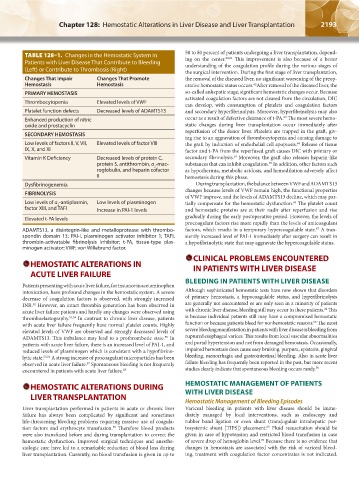
                   TABLE 128–1.  Changes in the Hemostatic System in    50 to 80 percent of patients undergoing a liver transplantation, depend-
                                                                                         This improvement is also because of a better
                                                                                      60,61
                                                                        ing on the center.
                   Patients with Liver Disease That Contribute to Bleeding   understanding of the coagulation profile during the various stages of
                   (Left) or Contribute to Thrombosis (Right)           the surgical intervention. During the first stage of liver transplantation,
                   Changes That Impair     Changes That Promote         the removal of the diseased liver, no significant worsening of the preop-
                   Hemostasis              Hemostasis                   erative hemostatic status occurs. After removal of the diseased liver, the
                                                                                               62
                   PRIMARY HEMOSTASIS                                   so-called anhepatic stage, significant hemostatic changes occur. Because
                                                                        activated coagulation factors are not cleared from the circulation, DIC
                   Thrombocytopenia        Elevated levels of VWF
                                                                        can develop, with consumption of platelets and coagulation factors
                   Platelet function defects  Decreased levels of ADAMTS13  and secondary hyperfibrinolysis. Moreover, hyperfibrinolysis may also
                                                                                                         63
                   Enhanced production of nitric                        occur as a result of defective clearance of t-PA.  The most severe hemo-
                   oxide and prostacyclin                               static changes during liver transplantation occur immediately after
                                                                        reperfusion of the donor liver. Platelets are trapped in the graft, giv-
                   SECONDARY HEMOSTASIS
                                                                        ing rise to an aggravation of thrombocytopenia and causing damage to
                   Low levels of factors II, V, VII,   Elevated levels of factor VIII  the graft by induction of endothelial cell apoptosis.  Release of tissue
                                                                                                              64
                   IX, X, and XI                                        factor and t-PA from the reperfused graft causes DIC with primary or
                                                                                         63
                   Vitamin K Deficiency    Decreased levels of protein C,   secondary fibrinolysis.  Moreover, the graft also releases heparin-like
                                           protein S, antithrombin, α -mac-  substances that can inhibit coagulation.  In addition, other factors such
                                                                                                     65
                                                              2
                                           roglobulin, and heparin cofactor   as hypothermia, metabolic acidosis, and hemodilution adversely affect
                                           II                           hemostasis during this phase.
                   Dysfibrinogenemia                                        During transplantation, the balance between VWF and ADAMTS13
                                                                        changes because levels of VWF remain high, the functional properties
                   FIBRINOLYSIS
                                                                        of VWF improve, and the levels of ADAMTS13 decline, which may par-
                   Low levels of α -antiplasmin,   Low levels of plasminogen  tially compensate for the hemostatic dysfunction.  The platelet count
                                                                                                             66
                              2
                   factor XIII, and TAFI   Increase in PAI-1 levels     and hemostatic proteins are at their  nadir  after  reperfusion  and  rise
                   Elevated t-PA levels                                 gradually during the early postoperative period. However, the levels of
                                                                        procoagulant factors rise more rapidly than the levels of anticoagulant
                                                                                                                    67
                  ADAMTS13, a disintegrin-like and metalloprotease with thrombo-  factors, which results in a temporary hypercoagulable state.  A tran-
                  spondin domain 13; PAI-I, plasminogen activator inhibitor 1; TAFI,   siently increased level of PAI-1 immediately after surgery can result in
                  thrombin-activatable fibrinolysis inhibitor; t-PA, tissue-type plas-  a hypofibrinolytic state that may aggravate the hypercoagulable status.
                  minogen activator; VWF, von Willebrand factor.
                                                                             CLINICAL PROBLEMS ENCOUNTERED
                       HEMOSTATIC ALTERATIONS IN                           IN PATIENTS WITH LIVER DISEASE
                     ACUTE LIVER FAILURE
                                                                        BLEEDING IN PATIENTS WITH LIVER DISEASE
                  Patients presenting with acute liver failure, for instance in acetaminophen
                  intoxication, have profound changes in the hemostatic system. A severe   Although sophisticated hemostatic tests have now shown that disorders
                  decrease of coagulation factors is observed, with strongly increased   of primary hemostasis, a hypocoagulable status, and hyperfibrinolysis
                  INR.  However, an intact thrombin generation has been observed in   are generally not encountered or are only seen in a minority of patients
                     52
                                                                                                                       24
                  acute liver failure patients and hardly any changes were observed using   with chronic liver disease, bleeding still may occur in these patients.  This
                  thromboelastography. 53,54  In contrast to chronic liver disease, patients   is because individual patients still may have a compromised hemostatic
                                                                                                                   68
                  with acute liver failure frequently have normal platelet counts. Highly   function or because patients bleed for nonhemostatic reasons.  The most
                  elevated levels of VWF are observed and strongly decreased levels of   severe bleeding manifestation in patients with liver disease is bleeding from
                  ADAMTS13. This imbalance may lead to a prothrombotic state.  In   ruptured esophageal varices. This results from local vascular abnormalities
                                                                  55
                  patients with acute liver failure, there is an increased level of PAI-1, and   and portal hypertension and not from deranged hemostasis. Occasionally,
                  reduced levels of plasminogen which is consistent with a hypofibrino-  impaired hemostasis does cause easy bruising, purpura, epistaxis, gingival
                  lytic state. 53,56  A strong increase of procoagulant microparticles has been   bleeding, menorrhagia and gastrointestinal bleeding. Also in acute liver
                  observed in acute liver failure.  Spontaneous bleeding is not frequently   failure bleeding has frequently been reported in the past, but more recent
                                       57
                  encountered in patients with acute liver failure. 58  studies clearly indicate that spontaneous bleeding occurs rarely. 58
                       HEMOSTATIC ALTERATIONS DURING                    HEMOSTATIC MANAGEMENT OF PATIENTS
                     LIVER TRANSPLANTATION                              WITH LIVER DISEASE
                                                                        Hemostatic Management of Bleeding Episodes
                  Liver transplantation performed in patients in acute or chronic liver   Variceal  bleeding in patients with liver disease should be imme-
                  failure has always been complicated by significant and sometimes   diately managed by local interventions, such as endoscopy and
                  life-threatening bleeding problems requiring massive use of coagula-  rubber band ligation or even shunt (transjugulair intrahepatic por-
                  tion factors and erythrocyte transfusion.  Therefore blood products   tosystemic shunt [TIPS]) placement.  Fluid resuscitation should be
                                                                                                    69
                                                59
                  were also transfused before and during transplantation to correct the   given in case of hypotension and restricted blood transfusion in case
                  hemostatic dysfunction. Improved surgical techniques and anesthe-  of severe drop of hemoglobin level.  Because there is no evidence that
                                                                                                  70
                  siologic care have led to a remarkable reduction of blood loss during   changes in hemostasis are associated with the risk of variceal  bleed-
                  liver transplantation. Currently, no blood transfusion is given in up to    ing, treatment with coagulation factor concentrates is not indicated.


          Kaushansky_chapter 128_p2191-2198.indd   2193                                                                 9/18/15   10:38 AM

