


Page 386 - Williams Hematology ( PDFDrive )
P. 386
360  Part V:  Therapeutic Principles                        Chapter 23:  Hematopoietic Cell Transplantation           361


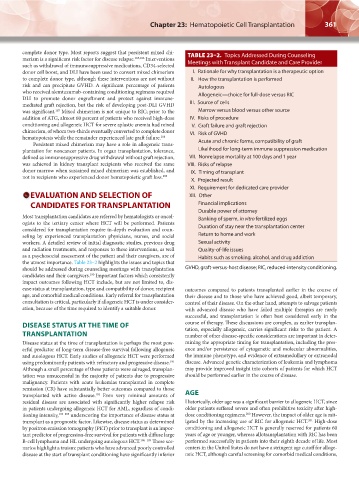
                  complete donor type. Most reports suggest that persistent mixed chi-  TABLE 23–2.  Topics Addressed During Counseling
                  merism is a significant risk factor for disease relapse. 185,186  Interventions
                  such as withdrawal of immunosuppressive medications, CD34-selected   Meetings with Transplant Candidate and Care Provider
                  donor cell boost, and DLI have been used to convert mixed chimerism   I.  Rationale for why transplantation is a therapeutic option
                  to complete donor type, although these interventions are not without   II.   How the transplantation is performed
                  risk and can precipitate GVHD. A significant percentage of patients   Autologous
                  who received alemtuzumab-containing conditioning regimens required   Allogeneic—choice for full-dose versus RIC
                  DLI to promote donor engraftment and protect against immune-
                  mediated graft rejection, but the risk of developing post-DLI GVHD   III.  Source of cells
                  was significant.  Mixed chimerism is not unique to RIC; prior to the   Marrow versus blood versus other source
                             187
                  addition of ATG, almost 60 percent of patients who received high-dose   IV.  Risks of procedure
                  conditioning and allogeneic HCT for severe aplastic anemia had mixed   V.  Graft failure and graft rejection
                  chimerism, of whom two-thirds eventually converted to complete donor   VI.  Risk of GVHD
                  hematopoiesis while the remainder experienced late graft failure. 188
                     Persistent mixed chimerism may have a role in allogeneic trans-  Acute and chronic forms, compatibility of graft
                  plantation for noncancer patients. In organ transplantation, tolerance,   Likelihood for long-term immune suppression medication
                  defined as immunosuppressive drug withdrawal without graft rejection,   VII.  Nonrelapse mortality at 100 days and 1 year
                  was achieved in kidney transplant recipients who received the same   VIII.  Risks of relapse
                  donor marrow when sustained mixed chimerism was established, and   IX.  Timing of transplant
                  not in recipients who experienced donor hematopoietic graft loss. 189  X.  Projected result
                                                                          XI.  Requirement for dedicated care provider
                       EVALUATION AND SELECTION OF                        XII.  Other
                     CANDIDATES FOR TRANSPLANTATION                          Financial implications
                                                                             Durable power of attorney
                  Most transplantation candidates are referred by hematologists or oncol-  Banking of sperm, in vitro fertilized eggs
                  ogists  to  the  tertiary  center  where  HCT  will  be  performed.  Patients
                  considered for transplantation require in-depth evaluation and coun-  Duration of stay near the transplantation center
                  seling by experienced transplantation physicians, nurses, and social   Return to home and work
                  workers. A detailed review of initial diagnostic studies, previous drug   Sexual activity
                  and radiation treatments, and responses to these interventions, as well   Quality-of-life issues
                  as a psychosocial assessment of the patient and their caregivers, are of   Habits such as smoking, alcohol, and drug addiction
                  the utmost importance. Table 23–2 highlights the issues and topics that
                  should be addressed during counseling meetings with transplantation   GVHD, graft-versus-host disease; RIC, reduced-intensity conditioning.
                  candidates and their caregivers.  Important factors which consistently
                                        190
                  impact outcomes following HCT include, but are not limited to, dis-
                  ease status at transplantation, type and compatibility of donor, recipient   outcomes compared to patients transplanted earlier in the course of
                  age, and comorbid medical conditions. Early referral for transplantation   their disease and to those who have achieved good, albeit temporary,
                  consultation is critical, particularly if allogeneic HCT is under consider-  control of their disease. On the other hand, attempts to salvage patients
                  ation, because of the time required to identify a suitable donor.  with advanced disease who have failed multiple therapies are rarely
                                                                        successful, and transplantation is often best considered early in the
                  DISEASE STATUS AT THE TIME OF                         course of therapy. These discussions are complex, as earlier transplan-
                                                                        tation, especially allogeneic, carries significant risks to the patient. A
                  TRANSPLANTATION                                       number of other disease-specific considerations are important in deter-
                  Disease status at the time of transplantation is perhaps the most pow-  mining the appropriate timing for transplantation, including the pres-
                  erful predictor of long-term disease-free survival following allogeneic   ence and/or persistence of cytogenetic and molecular abnormalities,
                  and autologous HCT. Early studies of allogeneic HCT were performed   the immune phenotype, and evidence of extramedullary or extranodal
                  using predominantly patients with refractory and progressive disease.    disease. Advanced genetic characterization of leukemia and lymphoma
                                                                   191
                  Although a small percentage of these patients were salvaged, transplan-  may provide improved insight into cohorts of patients for which HCT
                  tation was unsuccessful in the majority of patients due to progressive   should be performed earlier in the course of disease.
                  malignancy. Patients with acute leukemias transplanted in complete
                  remission (CR) have substantially better outcomes compared to those
                  transplanted with active disease.  Even very minimal amounts of   AGE
                                          192
                  residual disease are associated with significantly higher relapse risk   Historically, older age was a significant barrier to allogeneic HCT, since
                  in patients undergoing allogeneic HCT for AML, regardless of condi-  older patients suffered severe and often prohibitive toxicity after high-
                  tioning intensity, 193–195  underscoring the importance of disease status at   dose conditioning regimens.  However, the impact of older age is mit-
                                                                                             200
                  transplant as a prognostic factor. Likewise, disease status as determined   igated by the increasing use of RIC for allogeneic HCT.  High-dose
                                                                                                                  201
                  by positron emission tomography (PET) prior to transplant is an impor-  conditioning and allogeneic HCT is generally reserved for patients 60
                  tant predictor of progression-free survival for patients with diffuse large   years of age or younger, whereas allotransplantation with RIC has been
                  B-cell lymphoma and HL undergoing autologous HCT. 196–199  These sce-  performed successfully in patients into their eighth decade of life. Most
                  narios highlight a truism: patients who have advanced poorly controlled   centers in the United States do not have a stringent age cutoff for alloge-
                  disease at the start of transplant conditioning have significantly inferior   neic HCT, although careful screening for comorbid medical conditions,


          Kaushansky_chapter 23_p0353-0382.indd   361                                                                   9/19/15   12:46 AM

