


Page 392 - Williams Hematology ( PDFDrive )
P. 392
366  Part V:  Therapeutic Principles                        Chapter 23:  Hematopoietic Cell Transplantation           367


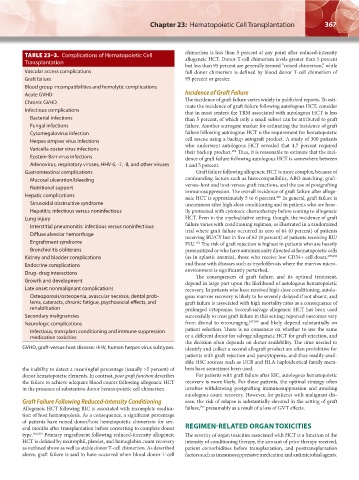
                   TABLE 23–3.  Complications of Hematopoietic Cell     chimerism is less than 5 percent at any point after reduced-intensity
                                                                        allogeneic HCT. Donor T-cell chimerism levels greater than 5 percent
                   Transplantation
                                                                        but less than 95 percent are generally termed “mixed chimerism,” while
                   Vascular access complications                        full donor chimerism is defined by blood donor T-cell chimerism of
                   Graft failure                                        95 percent or greater.
                   Blood group incompatibilities and hemolytic complications
                   Acute GVHD                                           Incidence of Graft Failure
                   Chronic GVHD                                         The incidence of graft failure varies widely in published reports. To esti-
                                                                        mate the incidence of graft failure following autologous HCT, consider
                   Infectious complications                             that in most centers the TRM associated with autologous HCT is less
                     Bacterial infections                               than 5 percent, of which only a small subset can be attributed to graft
                     Fungal infections                                  failure. Another surrogate marker for estimating the incidence of graft
                     Cytomegalovirus infection                          failure following autologous HCT is the requirement for hematopoietic
                     Herpes simplex virus infections                    cell rescue using a backup autograft product. A study of 300 patients
                     Varicella-zoster virus infections                  who underwent autologous HCT revealed that 4.7 percent required
                                                                                        294
                                                                        their backup product.  Thus, it is reasonable to estimate that the inci-
                     Epstein-Barr virus infections                      dence of graft failure following autologous HCT is somewhere between
                     Adenovirus, respiratory viruses, HHV-6, -7, -8, and other viruses  1 and 5 percent.
                   Gastrointestinal complications                           Graft failure following allogeneic HCT is more complex, because of
                     Mucosal ulceration/bleeding                        confounding factors such as histocompatibility, ABO matching, graft-
                     Nutritional support                                versus-host and host-versus-graft reactions, and the use of postgrafting
                                                                        immunosuppression. The overall incidence of graft failure after alloge-
                   Hepatic complications                                neic HCT is approximately 5 to 6 percent.  In general, graft failure is
                                                                                                       295
                     Sinusoidal obstructive syndrome                    uncommon after high-dose conditioning and in patients who are heav-
                     Hepatitis: infectious versus noninfectious         ily pretreated with cytotoxic chemotherapy before coming to allogeneic
                   Lung injury                                          HCT. Even in the myeloablative setting, though, the incidence of graft
                     Interstitial pneumonitis: infectious versus noninfectious  failure varies with conditioning regimen, as illustrated in a randomized
                     Diffuse alveolar hemorrhage                        trial where graft failure occurred in zero of 64 (0 percent) of patients
                                                                        receiving BU/CY but in five of 62 (8 percent) of patients receiving BU/
                     Engraftment syndrome                               FLU.  The risk of graft rejection is highest in patients who are heavily
                                                                            174
                     Bronchiolitis obliterans                           presensitized or who have autoimmunity directed at hematopoietic cells
                   Kidney and bladder complications                     (as in aplastic anemia), those who receive low CD34+ cell doses, 295,296
                   Endocrine complications                              and those with diseases such as myelofibrosis where the marrow micro-
                   Drug–drug interactions                               environment is significantly perturbed.
                                                                            The consequences of graft failure, and its optimal treatment,
                   Growth and development                               depend in large part upon the likelihood of autologous hematopoietic
                   Late onset nonmalignant complications                recovery. In patients who have received high-dose conditioning, autolo-
                      Osteoporosis/osteopenia, avascular necrosis, dental prob-  gous marrow recovery is likely to be severely delayed if not absent, and
                    lems, cataracts, chronic fatigue, psychosocial effects, and   graft failure is associated with high mortality rates as a consequence of
                    rehabilitation                                      prolonged cytopenias. Second-salvage allogeneic HCT has been used
                   Secondary malignancies                               successfully to treat graft failure in this setting; reported outcomes vary
                   Neurologic complications                             from dismal to encouraging, 297,298  and likely depend substantially on
                      Infectious, transplant conditioning and immune suppression   patient selection. There is no consensus on whether to use the same
                    medication toxicities                               or a different donor for salvage allogeneic HCT for graft rejection, and
                                                                        the decision often depends on donor availability. The time needed to
                  GVHD, graft-versus-host disease; HHV, human herpes virus subtypes.  identify and collect a second allograft product are often prohibitive for
                                                                        patients with graft rejection and pancytopenia, and thus readily avail-
                                                                        able HSC sources such as UCB and HLA-haploidentical family mem-
                  the inability to detect a meaningful percentage (usually >5 percent) of   bers have sometimes been used.
                  donor hematopoietic elements. In contrast, poor graft function describes   For patients with graft failure after RIC, autologous hematopoietic
                  the failure to achieve adequate blood counts following allogeneic HCT   recovery is more likely. For these patients, the optimal strategy often
                  in the presence of substantive donor hematopoietic cell chimerism.  involves  withdrawing  postgrafting  immunosuppression  and awaiting
                                                                        autologous count recovery. However, for patients with malignant dis-
                  Graft Failure Following Reduced-Intensity Conditioning  ease, the risk of relapse is substantially elevated in the setting of graft
                                                                             295
                  Allogeneic HCT following RIC is associated with incomplete eradica-  failure,  presumably as a result of a loss of GVT effects.
                  tion of host hematopoiesis. As a consequence, a significant percentage
                  of patients have mixed donor/host hematopoietic chimerism for sev-
                  eral months after transplantation before converting to complete donor   REGIMEN-RELATED ORGAN TOXICITIES
                  type. 186,293  Primary engraftment following reduced-intensity allogeneic   The severity of organ toxicities associated with HCT is a function of the
                  HCT is defined by neutrophil, platelet, and hemoglobin count recovery   intensity of conditioning therapy, the amount of prior therapy received,
                  as outlined above as well as stable donor T-cell chimerism. As described   patient  comorbidities  before transplantation,  and posttransplantation
                  above, graft failure is said to have occurred when blood donor T-cell   factors such as immunosuppressive medication and antimicrobial agents.


          Kaushansky_chapter 23_p0353-0382.indd   367                                                                   9/19/15   12:47 AM

