


Page 677 - Williams Hematology ( PDFDrive )
P. 677
652            Part VI:  The Erythrocyte                                                                                                              Chapter 44:  Anemia Resulting From Other Nutritional Deficiencies            653


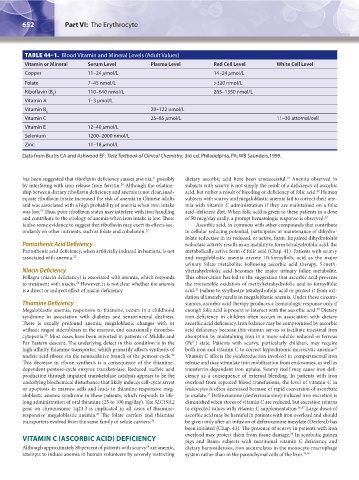
                TABLE 44–1.  Blood Vitamin and Mineral Levels (Adult Values)
                Vitamin or Mineral   Serum Level          Plasma Level          Red Cell Level       White Cell Level
                Copper               11–24 μmol/L                               14–24 μmol/L
                Folate               7–45 nmol/L                                >320 nmol/L
                Riboflavin (B )      110–640 nmol/L                             265–1350 nmol/L
                          2
                Vitamin A            1–3 μmol/L
                Vitamin B                                 20–122 nmol/L
                       6
                Vitamin C                                 25–85 μmol/L                               11–30 attomol/cell
                Vitamin E            12–40 μmol/L
                Selenium             1200–2000 nmol/L
                Zinc                 11–18 μmol/L
               Data from Burtis CA and Ashwood EF: Tietz Textbook of Clinical Chemistry, 3rd ed. Philadelphia, PA: WB Saunders,1999.


                                                           21
                                                                                                        30
               has been suggested that riboflavin deficiency causes anemia,  possibly   dietary ascorbic acid have been unsuccessful.  Anemia observed in
                                                20
               by interfering with iron release from ferritin.  Although the relation-  subjects with scurvy is not simply the result of a deficiency of ascorbic
               ship between dietary riboflavin deficiency and anemia is not clear, inad-  acid, but rather a result of bleeding or deficiency of folic acid.  Human
                                                                                                                  29
               equate riboflavin intake increased the risk of anemia in Chinese adults   subjects with scurvy and megaloblastic anemia fail to correct their ane-
               and was associated with a high probability of anemia when iron intake   mia with vitamin C administration if they are maintained on a folic
                     16
               was low.  Thus, poor riboflavin status may interfere with iron handling   acid–deficient diet. When folic acid is given to these patients in a dose
               and contribute to the etiology of anemia when iron intake is low. There   of 50 mcg/day orally, a prompt hematologic response is observed. 31
               is also some evidence to suggest that riboflavin may exert its effects sec-  Ascorbic acid, in common with other compounds that contribute
               ondarily on other nutrients, such as folate and cobalamin. 22  to cellular reducing potential, participates in maintenance of dihydro-
                                                                      folate reductase in its reduced, or active, form. Impaired dihydrofolate
               Pantothenic Acid Deficiency                            reductase activity results in an inability to form tetrahydrofolic acid, the
               Pantothenic acid deficiency, when artificially induced in humans, is not   metabolically active form of folic acid (Chap. 41). Patients with scurvy
               associated with anemia. 23                             and megaloblastic anemia excrete 10-formylfolic acid as the major
                                                                      urinary folate metabolite. Following ascorbic acid therapy, 5-meth-
               Niacin Deficiency                                      yltetrahydrofolic acid becomes the major urinary folate metabolite.
               Pellagra (niacin deficiency) is associated with anemia, which responds   This observation has led to the suggestion that ascorbic acid prevents
               to treatment with niacin.  However, it is not clear whether the anemia   the irreversible oxidation of methyltetrahydrofolic acid to formylfolic
                                 24
               is a direct or indirect effect of niacin deficiency.   acid.  Failure to synthesize tetrahydrofolic acid or protect it from oxi-
                                                                         32
                                                                      dation ultimately results in megaloblastic anemia. Under these circum-
               Thiamine Deficiency                                    stances, ascorbic acid therapy produces a hematologic response only if
               Megaloblastic anemia, responsive to thiamine, occurs in a childhood   enough folic acid is present to interact with the ascorbic acid.  Dietary
                                                                                                                  33
               syndrome  in  association with  diabetes and  sensorineural  deafness.   iron deficiency in children often occurs in association with dietary
               There is usually profound anemia, megaloblastic changes with or   ascorbic acid deficiency. Iron balance may be compromised by ascorbic
               without ringed sideroblasts in the marrow, and occasionally thrombo-  acid deficiency because this vitamin serves to facilitate intestinal iron
               cytopenia.  Most cases have been reported in patients of Middle and   absorption by maintaining iron in a more soluble reduced or ferrous
                       25
               Far Eastern descent. The underlying defect in this condition is in the   (Fe )  state.  Patients  with  scurvy,  particularly  children,  may  require
                                                                        2+
                                                                                                                        34
               high-affinity thiamine transporter, which primarily affects synthesis of   both iron and vitamin C to correct hypochromic microcytic anemia.
               nucleic acid ribose via the nonoxidative branch of the pentose cycle.    Vitamin C affects the oxidoreduction involved in compartmental iron
                                                                 26
               This decrease in ribose synthesis is a consequence of the thiamine-   release and may stimulate iron mobilization from endosomes, as well as
               dependent pentose-cycle enzyme transketolase. Reduced nucleic acid   transferrin-dependent iron uptake. Scurvy itself may cause iron defi-
               production through impaired transketolase catalysis appears to be the   ciency as a consequence of external bleeding. In patients with iron
               underlying biochemical disturbance that likely induces cell-cycle arrest   overload from repeated blood transfusions, the level of vitamin C in
               or apoptosis in marrow cells and leads to thiamine-responsive meg-  leukocytes is often decreased because of rapid conversion of ascorbate
               aloblastic anemia syndrome in these patients, which responds to life-  to oxalate.  Deferoxamine (desferrioxamine)-induced iron excretion is
                                                                             35
               long administration of oral thiamine (25 to 100 mg/day). The SLC19A2   diminished when stores of vitamin C are reduced, but excretion returns
               gene on chromosome 1q23.3 is implicated in all cases of thiamine-   to expected values with vitamin C supplementation. 36,37  Large doses of
                                        27
               responsive  megaloblastic  anemia.   The  folate  carriers  and  thiamine   ascorbic acid may be harmful in patients with iron overload and should
               transporters evolved from the same family of solute carriers. 28  be given only after an infusion of deferoxamine mesylate (Desferal) has
                                                                      been initiated (Chap. 43). The presence of scurvy in patients with iron
                                                                                                         38
               VITAMIN C (ASCORBIC ACID) DEFICIENCY                   overload may protect them from tissue damage.  In scorbutic guinea
                                                                      pigs and Bantu subjects with nutritional vitamin C deficiency and
               Although approximately 80 percent of patients with scurvy  are anemic,   dietary hemosiderosis, iron accumulates in the monocyte-macrophage
                                                         29
               attempts to induce anemia in human volunteers by severely restricting   system rather than in the parenchymal cells of the liver. 39,40


          Kaushansky_chapter 44_p0651-0656.indd   652                                                                   9/17/15   6:30 PM

