


Page 1779 - Hall et al (2015) Principles of Critical Care-McGraw-Hill
P. 1779
1248     PART 11: Special Problems in Critical Care

                     ■  ANTINUCLEAR ANTIBODIES                         methods. The test is now performed most commonly on HEp-2 cells

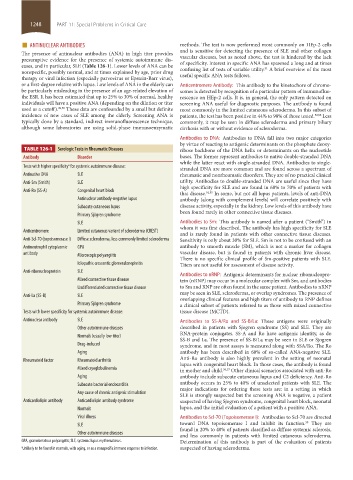
                 The presence of antinuclear antibodies (ANA) in high titer provides   and is sensitive for detecting the presence of SLE and other collagen
                                                                       vascular diseases, but as noted above, the test is hindered by the lack
                 presumptive evidence for the presence of systemic autoimmune dis-
                 eases, and in particular, SLE (Table 126-1). Lower levels of ANA can be   of specificity. Interest in specific ANA has spawned a long and at times
                                                                       confusing list of tests of variable utility.  A brief overview of the most
                                                                                                    51
                 nonspecific, possibly normal, and at times explained by age, prior drug
                 therapy or viral infection (especially parvovirus or Epstein-Barr virus),   useful specific ANA tests follows.
                 or a first-degree relative with lupus. Low levels of ANA in the elderly can   Anticentromere Antibody:  This antibody to the kinetochore of chromo-
                 be particularly misleading in the presence of an age-related elevation of   somes is detected by recognition of a particular pattern of immunofluo-
                 the ESR. It has been estimated that up to 25% to 30% of normal, healthy   rescence on HEp-2 cells. It is, in general, the only pattern detected on
                 individuals will have a positive ANA (depending on the dilution or titer   screening ANA useful for diagnostic purposes. The antibody is found
                 used as a cutoff). 49,50  These data are confounded by a small but definite   most commonly in the limited cutaneous scleroderma. In this subset of
                 incidence of new cases of SLE among the elderly. Screening ANA is   patients, the test has been positive in 44% to 98% of those tested. 52,53  Less
                 typically done by a standard, indirect immunofluorescence technique,   commonly, it may be seen in diffuse scleroderma and primary biliary
                 although some laboratories are using solid-phase immunoenzymatic   cirrhosis with or without evidence of scleroderma.
                                                                       Antibodies to DNA:  Antibodies to DNA fall into two major categories
                                                                       by virtue of reacting to antigenic determinants on the phosphate deoxy-
                   TABLE 126-1    Serologic Tests in Rheumatic Diseases  ribose backbone of the DNA helix or determinants on the nucleotide
                  Antibody          Disorder                           bases. The former represent antibodies to native double-stranded DNA
                                                                       while the latter react with single-stranded DNA. Antibodies to single-
                                 a
                  Tests with higher specificity  for systemic autoimmune disease:
                                                                       stranded DNA are more common and are found across a spectrum of
                  Antinative DNA    SLE                                rheumatic and nonrheumatic disorders. They are of no practical clinical
                  Anti-Sm (Smith)   SLE                                utility. Antibodies to double-stranded DNA are useful since they have
                                                                       high specificity for SLE and are found in 60% to 70% of patients with
                  Anti-Ro (SS-A)    Congenital heart block
                                                                       that disease. 54,55  In some, but not all lupus patients, levels of anti-DNA
                                    Antinuclear antibody-negative lupus  antibody (along with complement levels) will correlate positively with
                                    Subacute cutaneous lupus           disease activity, especially in the kidney. Low levels of this antibody have
                                                                       been found rarely in other connective tissue diseases.
                                    Primary Sjögren syndrome
                                    SLE                                Antibodies to Sm:  This antibody is named after a patient (“Smith”) in
                                                                       whom it was first described. The antibody has high specificity for SLE
                  Anticentromere    Limited cutaneous variant of scleroderma (CREST)
                                                                       and is rarely found in patients with other connective tissue diseases.
                  Anti-Scl-70 (topoisomerase I)  Diffuse scleroderma, less commonly limited scleroderma  Sensitivity is only about 30% for SLE. Sm is not to be confused with an
                  Antineutrophil cytoplasmic   GPA                     antibody to smooth muscle (SM), which is not a marker for collagen
                  antibody          Microscopic polyangiitis           vascular disease, but is found in patients with chronic liver disease.
                                                                       There is no specific clinical profile of Sm-positive patients with SLE.
                                    Idiopathic crescentic glomerulonephritis  Titers are not useful for assessment of disease activity.
                  Anti-ribonucleoprotein  SLE
                                                                       Antibodies to nRNP:  Antigenic determinants for nuclear ribonucleopro-
                                    Mixed connective tissue disease    tein (nRNP) may occur in a molecular complex with Sm, and antibodies
                                    Undifferentiated connective tissue disease  to Sm and RNP are often found in the same patient. Antibodies to nRNP
                                                                       may be seen in SLE, scleroderma, or overlap syndromes. The presence of
                  Anti-La (SS-B)    SLE
                                                                       overlapping clinical features and high titers of antibody to RNP defines
                                    Primary Sjögren syndrome           a clinical subset of patients referred to as those with mixed connective
                  Tests with lower specificity for systemic autoimmune disease:  tissue disease (MCTD).
                  Antinuclear antibody  SLE                            Antibodies to SS-A/Ro and SS-B/La:  These antigens were originally
                                    Other autoimmune diseases          described  in  patients  with  Sjogren  syndrome  (SS)  and  SLE.  They  are
                                                                       RNA-protein conjugates. SS-A and Ro have antigenic identity, as do
                                    Normals (usually low titer)
                                                                       SS-B and La. The presence of SS-B/La may be seen in SLE or Sjogren
                                    Drug-induced                       syndrome, and in most assays is measured along with SSA/Ro. The Ro
                                    Aging                              antibody has been described in 60% of so-called ANA-negative SLE.
                  Rheumatoid factor  Rheumatoid arthritis              Anti-Ro antibody is also highly prevalent in the setting of neonatal
                                                                       lupus with congenital heart block. In those cases, the antibody is found
                                    Mixed cryoglobulinemia             in mother and child. 56,57  Other clinical scenarios associated with anti-Ro
                                    Aging                              antibody include subacute cutaneous lupus and C2 deficiency. Anti-Ro
                                    Subacute bacterial endocarditis    antibody occurs in 25% to 40% of unselected patients with SLE. The
                                                                       major  indications  for  ordering  these  tests  are:  in  a  setting  in  which
                                    Any cause of chronic antigenic stimulation
                                                                       SLE is strongly suspected but the screening ANA is negative, a patient
                  Anticardiolipin antibody  Anticardiolipin antibody syndrome  suspected of having Sjogren syndrome, congenital heart block, neonatal
                                    Normals                            lupus, and the initial evaluation of a patient with a positive ANA.
                                    Viral illness                      Antibodies to Scl-70 (Topoisomerase I):  Antibodies to Scl-70 are directed
                                                                                                                  58
                                    SLE                                toward DNA topoisomerase I and inhibit its function.  They are
                                                                       found in 20% to 40% of patients classified as diffuse systemic sclerosis,
                                    Other autoimmune diseases
                                                                       and less commonly in patients with limited cutaneous scleroderma.
                 GPA, granulomatous polyangiitis; SLE, systemic lupus erythematosus.  Determination of this antibody is  part of the evaluation of patients
                 a Unlikely to be found in normals, with aging, or as a nonspecific immune response to infection.  suspected of having scleroderma.


            section11.indd   1248                                                                                      1/19/2015   10:52:16 AM

