


Page 699 - Hall et al (2015) Principles of Critical Care-McGraw-Hill
P. 699
518     PART 4: Pulmonary Disorders


                 lung tissue tethers open adjacent airways. Ground-glass opacifications   dyspnea or radiographic changes.  With time, arterial hypoxemia
                                                                                                 75
                 are either absent or minimal. 68                      and a widened (a-a)D O 2  are found at rest. In 20% of patients, arterial
                   Other causes of lower lobe–predominant infiltrates include fibrosis   hypoxemia is worse in the upright position and improved with recum-
                 associated with connective tissue disorders, asbestosis, and chronic   bency.  This paradoxical pattern is also seen with patent foramen ovale,
                                                                            73
                 aspiration.  Upper  lobe–predominant  lesions  include  sarcoidosis,   intrapulmonary arteriovenous malformation, and hepatopulmonary
                   tuberculosis, fungal infections, silicosis, allergic bronchopulmonary   syndrome. Arterial saturation also falls significantly in many patients
                 aspergillosis, Langerhans cell histiocytosis, ankylosing spondylitis,   during REM sleep. 71,73  Sleep-related hypoxemia is due to the exaggerated
                 berylliosis, cystic fibrosis, and hypersensitivity pneumonitis. If hilar   effects of normal nocturnal hypoventilation and V ˙ /Q ˙  variance. Alveolar
                 adenopathy is present, sarcoidosis, tuberculosis, endemic myco-  hypoventilation from respiratory muscle dysfunction or obstructive
                 ses, malignancy, and berylliosis should be considered. Pleural effu-  sleep apnea also may be responsible. 71
                 sions suggest lymphangioleiomyomatosis, select connective tissue   The importance of an anatomic barrier to the diffusion of oxygen (sec-
                 disorders, asbestos-related lung disease, and drug-induced lung disease.    ondary to a thickened, fibrotic interstitium) has been debated. In eight
                 Extensive parenchymal cysts suggest Langerhans cell histiocytosis,   patients with varying types of interstitial lung disease, multiple inert gas
                 lymphangioleiomyomatosis, and lymphocytic interstitial pneumonia.   analysis showed that V ˙ /Q ˙  inequality was the principal defect; diffusion
                 These  conditions  can  result  in  diffuse  parenchymal  infiltrates  with    limitation contributed to none of the (a-a)D O 2  at rest and only 19% of the
                 normal or increased lung volumes, as can a mixed process of emphy-  (a-a)D O 2  during exercise.  However, in 15 patients with IPF also studied
                                                                                         79
                 sema and IPF.                                         by multiple inert gas elimination, 19% of the (a-a)D O 2  at rest and 40%
                     ■  RESPIRATORY MECHANICS                          of the (a-a)D O 2  during exercise was attributed to diffusion limitation.
                                                                                                                          80
                                                                       V ˙ /Q ˙  inequality remained the principal defect, contributing to 81% of the
                                                                                                      –
                 In end-stage pulmonary fibrosis, pulmonary function tests typically   (a-a)D O 2  at rest, and a combination of low Pv  from an inadequate cardiac
                                                                                                      O 2
                 show reduced TLC, VC, and IC (see Fig. 58-2). FRC and RV are also   output, diffusion limitation, and high V ˙ /Q ˙  variance accounted for the
                 reduced, though usually to a lesser extent than TLC or VC. Rarely, RV   widening of the (a-a)D O 2  during exercise. Intrapulmonary shunt was
                 is normal when there is early airway closure or decreased elastic recoil   small, averaging 2% of cardiac output at rest and 3% during exercise.
                 pressure at low lung volumes.  Both the forced vital capacity (FVC)   The dead space to tidal volume ratio (V /V ) may exceed 0.4 (normal
                                        75
                                                                                                        t
                                                                                                     ds
                                                                                           71
                 and the forced expiratory volume in 1 second (FEV ) are decreased, but   ≤0.3) in end-stage fibrosis.  This reflects an increase in the volume of
                                                      1
                 FEV /FVC is generally increased. In this instance, high expiratory flow   alveolar dead space and a decrease in tidal volume. When V /V  is high,
                                                                                                                  ds
                                                                                                                     t
                    1
                 rates relative to volume reflect increased elastic recoil pressure. Airway   greater minute ventilation is required to maintain alveolar ventilation
                 resistance is usually normal or low, although reversible and irreversible   and a normal Pa CO 2 . Patients may surpass these heightened requirements
                 obstructive defects do occur.                         to achieve respiratory alkalosis, perhaps in response to greater afferent
                                                                                             70
                   Since chest wall compliance and respiratory muscles are normal in   stimuli from the fibrotic lung.  The development of hypercapnia is an
                 most patients with pulmonary fibrosis, lung volumes are affected by   ominous sign of imminent death.
                 lung (Fig. 58-4).  The P-V curve is shifted downward and to the right,   ■  EFFECTS ON THE PULMONARY CIRCULATION
                 changes in the pressure-volume (P-V) relationship of the noncompliant
                             76
                 such that increased elastic recoil of the lung limits TLC despite a very   Pulmonary hypertension and cor pulmonale are common in patients with
                 large transpulmonary pressure. The noncompliant respiratory system   end-stage pulmonary fibrosis, correlating with a DL  <45% predicted
                                                                                                             CO
                 requires patients to generate large negative pleural pressures during   and a VC <50% predicted.  Pulmonary hypertension occurs when blood
                                                                                          82
                 inspiration and is the reason why patients prefer a fast and shallow   vessels are altered by the fibrotic process, microthrombi, or hypoxic pul-
                 respiratory pattern. Smaller tidal volumes are an adaptive response to   monary vasoconstriction. Since polycythemia and high cardiac output
                 minimize work of breathing, which can be five to six times normal. 77  are uncommon in IPF, they rarely contribute to pulmonary hypertension.
                     ■  GAS EXCHANGE                                   Supplemental oxygen may alleviate hypoxic pulmonary vasoconstriction,
                                                                       but pulmonary hypertension resulting from destroyed and distorted vas-
                 Exercise-induced hypoxemia and a low single-breath diffusing capacity   culature is likely irreversible. Pulmonary hypertension has been associated
                 (DL ) are hallmarks of early disease.  Indeed, they may occur before   with redistribution of pulmonary blood flow to the upper lobes,  a pattern
                                                                                                                   74
                                             78
                    CO
                                                                       that rarely normalizes after corticosteroids.  Because pulmonary vascular
                                                                                                     81
                                                                       resistance is high, the gradient between the pulmonary artery diastolic
                    110
                                                                       pressure and the pulmonary capillary wedge pressure is wide. In patients
                                                                       with IPF and pulmonary hypertension, the phosphodiesterase inhibitor
                                                                       sildenafil has been associated with improvement in symptom scores and
                    90                                                 exercise capacity but not an increase in survival. 83-85
                                                                           ■
                   % TLC predicted  70                                 Whether acute deterioration is reversible depends on the severity of
                                                                          ACUTE CARDIOPULMONARY FAILURE
                                                                       pulmonary fibrosis, the extent of comorbidities, the nature and severity
                                                                       ing disease process.
                    50                                                 of the acute insult, and whether the acute insult accelerates the underly-
                                                                                     72
                                                                           ■  OUTCOME
                    30                                                 ICU management including the use of mechanical ventilation may be
                     –10       0       10       20       30       40   appropriate for select patients with pulmonary fibrosis: (1) patients
                                         P  (cm H O)                   with early/mild disease, particularly in the absence of a firm diagnosis,
                                               2
                                         tm
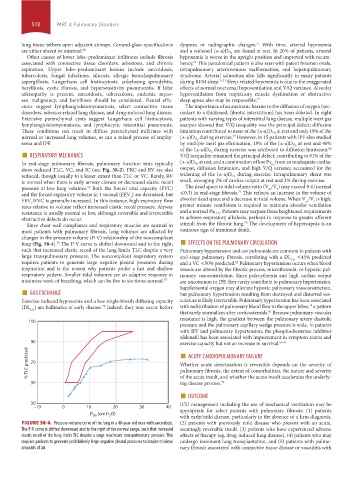
                 FIGURE 58-4.  Pressure-volume curve of the lung in a 48-year-old man with sarcoidosis.   (2) patients with previously mild disease who present with an acute,
                 The P-V curve is shifted downward and to the right of the normal range, such that increased   seemingly reversible insult, (3) patients who have experienced adverse
                 elastic recoil of the lung limits TLC despite a large maximum transpulmonary pressure. This   effects of therapy (eg, drug-induced lung disease), (4) patients who may
                 requires patients to generate prohibitively large negative pleural pressures to inspire minimal   undergo imminent lung transplantation, and (5) patients with pulmo-
                 amounts of air.                                       nary fibrosis associated with connective tissue disease or vasculitis with


            section04.indd   518                                                                                       1/23/2015   2:20:30 PM

