


Page 15 - SC4Q-2019-
P. 15
LEARNING               The Erudite: Transformative
       CURVES


           Dermatological Skills in Clinical Practice


                                                 By: Dr. Melanie Joy Doria-Ruiz, DPDS

            he  17th  post  graduate  course  marks  a
            few  firsts  for  the  JRRMMC  Department
        Tof Dermatology. In the recent past years,
        the previous venue proved to be inadequate in
        size, It was a leap of faith to hold it this year,
        in the Crowne Plaza’s Grand Ballroom; a bigger
        and  better  area,  although  this  entailed  more
        responsibilities. In this event, we also launched
        The Filipino Skin Lecture Series: An Anthology
        of  Challenging  and  Interesting  Cases.  Having
        been assigned as the institution’s Head of the
        Scientific Committee for the past few years, it
        has always been my desire to include cases that
        have been handled in the clinics. The conditions
        can  be  rare  in  occurrence  or  interesting  and
        complex,  whether  in  terms  of  diagnosis  or
        management.  Dermatologic  diseases  and
        conditions traverse age, gender, ethnicity and
        other factors; however, the focus on the cases
        encountered  in  our  country  is  necessary.  We
        are aware that there are limiting factors in our
        practice;  certain  diagnostic  tests,  medications
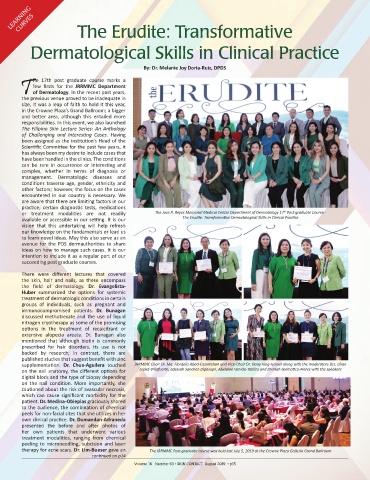
        or  treatment  modalities  are  not  readily   The Jose R. Reyes Memorial Medical Center Department of Dermatology 17  Post-graduate Course -
                                                                                               th
        available or accessible in our setting. It is our    The Erudite: Transformative Dermatological Skills in Clinical Practice
        vision  that  this  undertaking  will  help  refresh
        our knowledge on the fundamentals or lead us
        to learn novel ideas. May this also serve as an
        avenue  for  the  PDS  dermauthorities  to  share
        ideas on how to manage such cases. It is our
        intention to include it as a regular part of our
        succeeding post graduate courses.

        There  were  different  lectures  that  covered
        the  skin,  hair  and  nails,  as  these  encompass
        the  field  of  dermatology.  Dr.  Evangelista-
        Huber  summarized  the  options  for  systemic
        treatment of dermatologic conditions in certain
        groups  of  individuals,  such  as  pregnant  and
        immunocompromised  patients.  Dr.  Bunagan
        discussed  methotrexate  and  the  use  of  liquid
        nitrogen cryotherapy as some of the promising
        options  in  the  treatment  of  recalcitrant  or
        extensive  alopecia  areata.  Dr.  Bunagan  also
        mentioned  that  although  biotin  is  commonly
        prescribed  for  hair  disorders,  its  use  is  not
        backed  by  research;  in  contrast,  there  are
        published studies that suggest benefit with zinc
        supplementation.  Dr.  Chua-Aguilera  touched   JRRMMC Chair Dr. Ma. Flordeliz Abad-Casintahan and Vice-Chair Dr. Daisy King-Ismael along with the moderators Drs. Lilian
        on the nail anatomy, the different options for   Lopez-Villafuerte, Edessah Sanchez-Dipasupil, Abelaine Venida-Tablizo and Zharlah Gulmatico-Flores with the speakers
        digital block and the type of biopsy depending
        on  the  nail  condition.  More  importantly,  she
        cautioned about the risk of avascular necrosis,
        which  can  cause  significant  morbidity  for  the
        patient. Dr. Medina-Oblepias graciously shared
        to the audience, the combination of chemical
        peels for non-facial sites that she utilizes in her
        own clinical practice. Dr. Dumandan-Adraneda
        presented  the  before  and  after  photos  of
        her  own  patients  that  underwent  various
        treatment  modalities,  ranging  from  chemical
        peeling  to  microneedling,  subcision  and  laser
        therapy for acne scars. Dr. Lim-Bueser gave an   The JRRMMC Post-graduate course was held last July 5, 2019 at the Crowne Plaza Galleria Grand Ballroom
                               continued on p14
                                             Volume 16   Number 63 • SKIN CONTACT  August 2019  • p15

