


Page 195 - CRC_One Report 2021_EN
P. 195
Business Overview and Performance      Corporate Governance     Financial Statements   Enclosure


         3.3.2.3 Waste Management


         The Company focuses on the management of waste generated from the Company’s business operation, which can
         cause negative impact on the Company, especially in the food business and department stores that produce huge
         amount of food surplus and food waste. Therefore, the Company has developed an action plan and set appropriate
         target to reduce food waste, packaging waste and general solid waste that are generated throughout the entire
         value chain. Inefficient waste management can lead to various environmental problems such as greenhouse gas
         emissions from landfills, bad smell to the surrounding community, and contamination of water sources and soil.

         Under the guidance of the Company’s various sustainability management guidelines, the Company has implemented
         various Journey to Zero projects aimed at reducing the amount of waste. Moreover, the Company is committed to
         reducing food waste to landfill by half by 2030 in accordance with goal 12.3 of the UN SDGs and has established
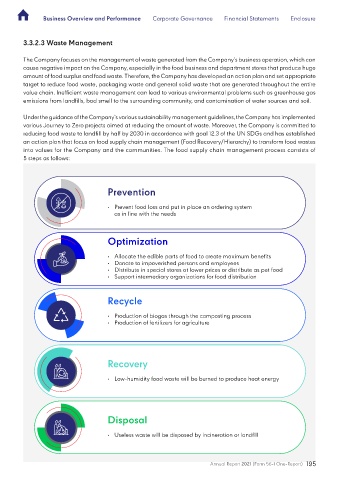
         an action plan that focus on food supply chain management (Food Recovery/Hierarchy) to transform food wastes
         into values for the Company and the communities. The food supply chain management process consists of
         5 steps as follows:


                                       Prevention


                                       •  Prevent food loss and put in place an ordering system
                                         as in line with the needs


                                       Optimization


                                       •  Allocate the edible parts of food to create maximum benefits
                                       •  Donate to impoverished persons and employees
                                       •  Distribute in special stores at lower prices or distribute as pet food
                                       •  Support intermediary organizations for food distribution


                                       Recycle


                                       •  Production of biogas through the composting process
                                       •  Production of fertilizers for agriculture


                                       Recovery


                                       •  Low-humidity food waste will be burned to produce heat energy


                                       Disposal


                                       •  Useless waste will be disposed by incineration or landfill


                                                                           Annual Report 2021 (Form 56-1 One-Report)  195

