


Page 104 - HOW TO PROVE IT: A Structured Approach, Second Edition
P. 104
P1: PIG/
                   0521861241c03  CB996/Velleman  October 20, 2005  2:42  0 521 86124 1  Char Count= 0


                                   90                          Proofs
                                   will usually be no explanation of how the mathematician thought of these
                                   transformations and inferences. For example, the proof in Example 3.1.2 starts
                                   with the sentence “Suppose 0 < a < b,” indicating that the problem has been
                                   transformed according to our strategy, and then proceeds with a sequence
                                                                            2
                                                                        2
                                   of inferences leading to the conclusion that a < b . No other explanations
                                   were necessary to justify the final conclusion, in the last sentence, that if
                                                     2
                                                 2
                                   0 < a < b then a < b .
                                     Although this lack of explanation sometimes makes proofs hard to read, it
                                   serves the purpose of keeping two distinct objectives separate: explaining your
                                   thought processes and justifying your conclusions. The first is psychology; the
                                   second, mathematics. The primary purpose of a proof is to justify the claim that
                                   the conclusion follows from the hypotheses, and no explanation of your thought
                                   processes can substitute for adequate justification of this claim. Keeping any
                                   discussion of thought processes to a minimum in a proof helps to keep this
                                   distinction clear. Occasionally, in a very complicated proof, a mathematician
                                   may include some discussion of the strategy behind the proof to make the
                                   proof easier to read. Usually, however, it is up to readers to figure this out
                                   for themselves. Don’t worry if you don’t immediately understand the strategy
                                   behind a proof you are reading. Just try to follow the justifications of the steps,
                                   and the strategy will eventually become clear. If it doesn’t, a second reading of
                                   the proof might help.
                                     To keep the distinction between the proof and the strategy behind the proof
                                   clear, in the future when we state a proof strategy we will often describe both
                                   the scratch work you might use to figure out the proof and the form that the
                                   final write-up of the proof should take. For example, here’s a restatement of
                                   the proof strategy we discussed earlier, in the form we will be using to present
                                   proof strategies from now on.
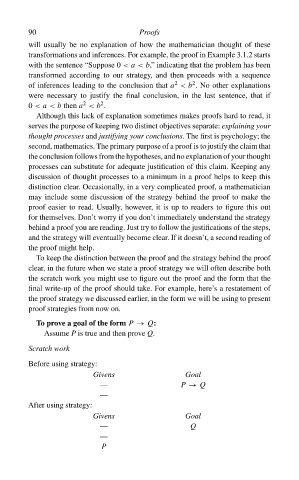
                                     To prove a goal of the form P → Q:
                                       Assume P is true and then prove Q.
                                   Scratch work

                                   Before using strategy:
                                                   Givens                  Goal
                                                     —                    P → Q
                                                     —
                                   After using strategy:
                                                   Givens                  Goal
                                                     —                      Q
                                                     —
                                                     P

