


Page 265 - HOW TO PROVE IT: A Structured Approach, Second Edition
P. 265
P1: Oyk/
                   0521861241c05  CB996/Velleman  October 19, 2005  0:16  0 521 86124 1  Char Count= 0


                                                  Inverses of Functions                251
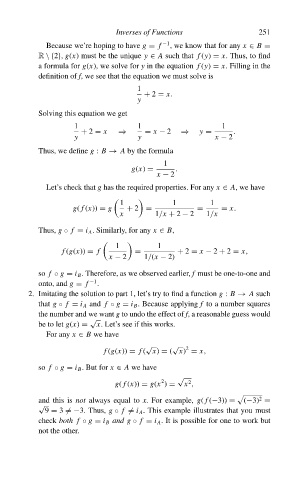
                                 Because we’re hoping to have g = f  −1 , we know that for any x ∈ B =
                               R \{2}, g(x) must be the unique y ∈ A such that f (y) = x. Thus, to find
                               a formula for g(x), we solve for y in the equation f (y) = x. Filling in the
                               definition of f, we see that the equation we must solve is
                                                        1
                                                          + 2 = x.
                                                        y
                               Solving this equation we get
                                        1               1                    1
                                         + 2 = x   ⇒      = x − 2  ⇒    y =     .
                                        y               y                   x − 2
                               Thus, we define g : B → A by the formula
                                                               1
                                                      g(x) =      .
                                                             x − 2
                                 Let’s check that g has the required properties. For any x ∈ A,wehave

                                                   1             1        1

                                       g( f (x)) = g  + 2 =            =     = x.
                                                   x        1/x + 2 − 2  1/x
                               Thus, g ◦ f = i A . Similarly, for any x ∈ B,


                                                  1          1
                                     f (g(x)) = f      =          + 2 = x − 2 + 2 = x,
                                                 x − 2    1/(x − 2)
                               so f ◦ g = i B . Therefore, as we observed earlier, f must be one-to-one and
                               onto, and g = f  −1 .
                            2. Imitating the solution to part 1, let’s try to find a function g : B → A such
                               that g ◦ f = i A and f ◦ g = i B . Because applying f to a number squares
                               the number and we want g to undo the effect of f, a reasonable guess would
                                            √
                               be to let g(x) =  x. Let’s see if this works.
                                 For any x ∈ B we have
                                                          √      √  2
                                               f (g(x)) = f ( x) = ( x) = x,
                               so f ◦ g = i B . But for x ∈ A we have
                                                                  √
                                                              2      2
                                                  g( f (x)) = g(x ) =  x ,

                                                                                       2
                               and this is not always equal to x. For example, g( f (−3)) =  (−3) =
                               √
                                9 = 3  =−3. Thus, g ◦ f  = i A . This example illustrates that you must
                               check both f ◦ g = i B and g ◦ f = i A . It is possible for one to work but
                               not the other.

