


Page 357 - HOW TO PROVE IT: A Structured Approach, Second Edition
P. 357
P1: PIG/
                   0521861241apx01  CB996/Velleman  October 20, 2005  2:56  0 521 86124 1  Char Count= 0


                                         Appendix 1: Solutions to Selected Exercises   343
                                                      Section 4.3
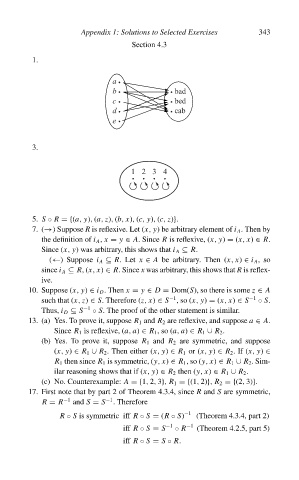
                             1.


                                                 a
                                                 b               bad
                                                 c               bed
                                                 d               cab
                                                 e


                             3.


                                                      12 3 4


                             5. S ◦ R ={(a, y), (a, z), (b, x), (c, y), (c, z)}.
                             7. (→) Suppose R is reflexive. Let (x, y) be arbitrary element of i A . Then by
                               the definition of i A , x = y ∈ A. Since R is reflexive, (x, y) = (x, x) ∈ R.
                               Since (x, y) was arbitrary, this shows that i A ⊆ R.
                                 (←) Suppose i A ⊆ R. Let x ∈ A be arbitrary. Then (x, x) ∈ i A ,so
                               since i A ⊆ R,(x, x) ∈ R. Since x was arbitrary, this shows that R is reflex-
                               ive.
                            10. Suppose (x, y) ∈ i D . Then x = y ∈ D = Dom(S), so there is some z ∈ A
                                                                −1
                               such that (x, z) ∈ S. Therefore (z, x) ∈ S ,so(x, y) = (x, x) ∈ S −1  ◦ S.
                               Thus, i D ⊆ S −1  ◦ S. The proof of the other statement is similar.
                            13. (a) Yes. To prove it, suppose R 1 and R 2 are reflexive, and suppose a ∈ A.
                                   Since R 1 is reflexive, (a, a) ∈ R 1 ,so(a, a) ∈ R 1 ∪ R 2 .
                               (b) Yes. To prove it, suppose R 1 and R 2 are symmetric, and suppose
                                   (x, y) ∈ R 1 ∪ R 2 . Then either (x, y) ∈ R 1 or (x, y) ∈ R 2 .If(x, y) ∈
                                   R 1 then since R 1 is symmetric, (y, x) ∈ R 1 ,so(y, x) ∈ R 1 ∪ R 2 . Sim-
                                   ilar reasoning shows that if (x, y) ∈ R 2 then (y, x) ∈ R 1 ∪ R 2 .
                               (c) No. Counterexample: A ={1, 2, 3}, R 1 ={(1, 2)}, R 2 ={(2, 3)}.
                            17. First note that by part 2 of Theorem 4.3.4, since R and S are symmetric,
                                                −1
                               R = R −1  and S = S . Therefore
                                    R ◦ S is symmetric iff R ◦ S = (R ◦ S) −1  (Theorem 4.3.4, part 2)
                                                    iff R ◦ S = S −1  ◦ R −1  (Theorem 4.2.5, part 5)
                                                    iff R ◦ S = S ◦ R.

