


Page 79 - HOW TO PROVE IT: A Structured Approach, Second Edition
P. 79
P1: PIG/  P2: Oyk/
                   0521861241c02  CB996/Velleman  October 19, 2005  23:48  0 521 86124 1  Char Count= 0


                                             Equivalences Involving Quantifiers          65
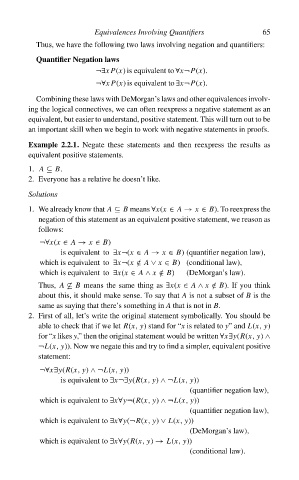
                              Thus, we have the following two laws involving negation and quantifiers:
                              Quantifier Negation laws
                                             ¬∃xP(x) is equivalent to ∀x¬P(x).
                                             ¬∀xP(x) is equivalent to ∃x¬P(x).
                              Combining these laws with DeMorgan’s laws and other equivalences involv-
                            ing the logical connectives, we can often reexpress a negative statement as an
                            equivalent, but easier to understand, positive statement. This will turn out to be
                            an important skill when we begin to work with negative statements in proofs.

                            Example 2.2.1. Negate these statements and then reexpress the results as
                            equivalent positive statements.

                            1. A ⊆ B.
                            2. Everyone has a relative he doesn’t like.

                            Solutions
                            1. We already know that A ⊆ B means ∀x(x ∈ A → x ∈ B). To reexpress the
                               negation of this statement as an equivalent positive statement, we reason as
                               follows:
                               ¬∀x(x ∈ A → x ∈ B)
                                    is equivalent to ∃x¬(x ∈ A → x ∈ B) (quantifier negation law),
                               which is equivalent to ∃x¬(x /∈ A ∨ x ∈ B) (conditional law),
                               which is equivalent to ∃x(x ∈ A ∧ x /∈ B)  (DeMorgan slaw).

                               Thus, A  ⊆ B means the same thing as ∃x(x ∈ A ∧ x /∈ B). If you think
                               about this, it should make sense. To say that A is not a subset of B is the
                               same as saying that there’s something in A that is not in B.
                            2. First of all, let’s write the original statement symbolically. You should be
                               able to check that if we let R(x, y) stand for “x is related to y” and L(x, y)
                               for “x likes y,” then the original statement would be written ∀x∃y(R(x, y) ∧
                               ¬L(x, y)). Now we negate this and try to find a simpler, equivalent positive
                               statement:

                               ¬∀x∃y(R(x, y) ∧¬L(x, y))
                                    is equivalent to ∃x¬∃y(R(x, y) ∧¬L(x, y))
                                                                     (quantifier negation law),
                               which is equivalent to ∃x∀y¬(R(x, y) ∧¬L(x, y))
                                                                     (quantifier negation law),
                               which is equivalent to ∃x∀y(¬R(x, y) ∨ L(x, y))
                                                                     (DeMorgan’s law),
                               which is equivalent to ∃x∀y(R(x, y) → L(x, y))
                                                                     (conditional law).

