


Page 6 - Electrostatics 11
P. 6
Grade 11                                                                              © GC Shiba
        Distribution of charge over the surface of conductor

        ☻ When a body is charged, the charge spreads all over the surface of the body

            which may or may not be uniform.
        ☻ The distribution of charge depends upon the shape of the conductor.
        ☻ The greater the curvature at any point, the greater will be the accumulation of
            charge.

        Types of charge distribution:
               1. Linear charge density (λ ): The charge per unit length of a body is called
                   linear charge density. i.e., λ =q/l

                              The charge distributed on a very thin straight rod.
               2. Surface charge density (σ ): The charge per unit area of a body is called
                   surface charge density. i.e., σ =q/A
                              The charge distributed uniformly on a thin disc.

               3. Volume charge density (ρ ): The charge per unit volume is called volume
                   charge density. i.e., ρ = q/V

                              The charge distributed inside a spherical non-conducting body.


        Action of points:


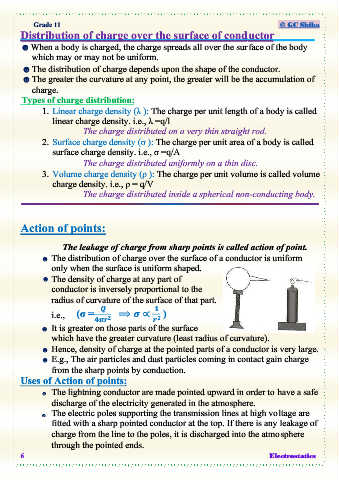
                       The leakage of charge from sharp points is called action of point.
               ☻ The distribution of charge over the surface of a conductor is uniform

                   only when the surface is uniform shaped.
               ☻ The density of charge at any part of
                   conductor is inversely proportional to the

                   radius of curvature of the surface of that part.

                   i.e.,     (σ =         ⟹    ∝            )

               ☻ It is greater on those parts of the surface

                   which have the greater curvature (least radius of curvature).
               ☻ Hence, density of charge at the pointed parts of a conductor is very large.
               ☻ E.g., The air particles and dust particles coming in contact gain charge
                   from the sharp points by conduction.

        Uses of Action of points:
               ☻  The lightning conductor are made pointed upward in order to have a safe

                   discharge of the electricity generated in the atmosphere.
               ☻  The electric poles supporting the transmission lines at high voltage are
                   fitted with a sharp pointed conductor at the top. If there is any leakage of
                   charge from the line to the poles, it is discharged into the atmosphere

                   through the pointed ends.
        6                                                                                       Electrostatics

