


Page 47 - PRE-U STPM MATHEMATICS (T) TERM 1
P. 47
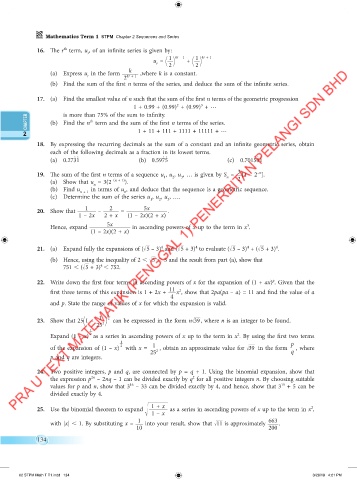
Mathematics Term 1  STPM  Chapter 2 Sequences and Series
              16.  The r  term, u , of an infinite series is given by:
                      th
                              r
                                                                 1
                                                    r 1 2
                                                   u  =   1  4r – 1  +  1 2 4r + 1
                                                        2
                                                                 2
                                           k
                 (a)  Express u  in the form   2 4r + 1   ,where k is a constant .
                             r
                 (b)  Find the sum of the first n terms of the series, and deduce the sum of the infinite series.
              17.  (a)  Find the smallest value of n such that the sum of the first n terms of the geometric progression
                                                                  3
                                                           2
                                            1 + 0.99 + (0.99)  + (0.99)  +  …
                      is more than 75% of the sum to infinity.
                              th
                 (b)  Find the n  term and the sum of the first n terms of the series.
         2                                    1 + 11 + 111 + 1111 + 11111 +  …
              18.  By expressing the recurring decimals as the sum of a constant and an infinite geometric series, obtain
                 each of the following decimals as a fraction in its lowest terms.
                                                                                    · · ·
                                                      · ·
                         · ·
                 (a)  0.2731                  (b)  0.597 5                 (c)  0.7015 0 1
              19.  The sum of the first n terms of a sequence u , u , u , … is given by S  =   3 [1 – 2 ].
                                                                                     –n
                                                            3
                                                         2
                                                                           n
                                                      1
                 (a)  Show that u  = 3(2 –(n + 1) ).                          2
                               n
                 (b)  Find u n + 1  in terms of u , and deduce that the sequence is a geometric sequence.
                                         n
                 (c)  Determine the sum of the series u , u , u , ….
                                                        3
                                                     2
                                                  1
              20.  Show that   1   –   2   =    5x      .
                           1 – 2x  2 + x   (1 – 2x)(2 + x)
                                                                                 3
                 Hence, expand      5x      in ascending powers of x up to the term in x .
                               (1 – 2x)(2 + x)
                                                                                           4
                                                                                 4
              21.  (a)  Expand fully the expansions of ( 5 – 3)  and ( 5 + 3)  to evaluate ( 5 – 3)  + ( 5 + 3) .
                                                     4
                                                                 4
                 (b)  Hence, using the inequality of 2 ,  5 , 3 and the result from part (a), show that
                      751 , ( 5 + 3) , 752.
                                  4
                                                                                          p
              22.  Write down the first four terms in ascending powers of x for the expansion of (1 + ax) . Given that the
                 first three terms of this expansion is 1 + 2x +  11  x , show that 2pa(pa – a) = 11 and find the value of a
                                                           2
                                                        4
                 and p. State the range of values of x for which the expansion is valid.
                                    1
                                 1
                            1
                                     2
              23.  Show that 25 1 –   25 22 —  can be expressed in the form n 39 , where n is an integer to be found.
                              1
                              —
                                                                              2
                              2
                 Expand (1 – x)  as a series in ascending powers of x up to the term in x . By using the first two terms
                                        — 1        1                                            p
                                        2
                 of the expansion of (1 – x)  with x =  25 2  , obtain an approximate value for  39  in the form   q  , where

                 p and q are integers.
              24.  Two positive integers,  p and  q, are connected by p =  q + 1. Using the binomial expansion, show that
                 the expression p  – 2nq – 1 can be divided exactly by q  for all positive integers n. By choosing suitable
                               2n
                                                                2
                                                                                            15
                                           16
                 values for p and n, show that 3  – 33 can be divided exactly by 4, and hence, show that 3  + 5 can be
                 divided exactly by 4.
              25.  Use the binomial theorem to expand   1 + x   as a series in ascending powers of x up to the term in x ,
                                                                                                      2
                                                  1 – x
                 with |x| , 1. By substituting x =   1   into your result, show that  11 is approximately   663  .
                                             10                                         200
             134
       02 STPM Math T T1.indd   134                                                                    3/28/18   4:21 PM

