


Page 44 - Q & A STPM 2022 Biology
P. 44
Biology STPM  Chapter 7 Gaseous Exchange


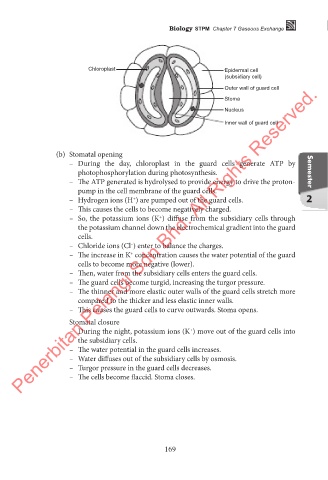
                            Chloroplast                         Epidermal cell
                                                                (subsidiary cell)
          Penerbitan Pelangi Sdn Bhd. All Rights Reserved.
                                                                Outer wall of guard cell
                                                                Stoma
                                                                Nucleus
                                                                Inner wall of guard cell


                   (b)  Stomatal opening
                       –  During the day, chloroplast in the guard cells generate ATP by
                         photophosphorylation during photosynthesis.                 Semester
                       –  The ATP generated is hydrolysed to provide energy to drive the proton-
                         pump in the cell membrane of the guard cells.
                       –  Hydrogen ions (H ) are pumped out of the guard cells.      2
                                        +
                       –  This causes the cells to become negatively charged.
                       –  So, the potassium ions (K ) diffuse from the subsidiary cells through
                                               +
                         the potassium channel down the electrochemical gradient into the guard
                         cells.
                       –  Chloride ions (Cl ) enter to balance the charges.
                                       –
                       –  The increase in K  concentration causes the water potential of the guard
                                       +
                         cells to become more negative (lower).
                       –  Then, water from the subsidiary cells enters the guard cells.
                       –  The guard cells become turgid, increasing the turgor pressure.
                       –  The thinner and more elastic outer walls of the guard cells stretch more
                         compared to the thicker and less elastic inner walls.
                       –  This causes the guard cells to curve outwards. Stoma opens.
                       Stomatal closure
                       –  During the night, potassium ions (K ) move out of the guard cells into
                                                       +
                         the subsidiary cells.
                       –  The water potential in the guard cells increases.
                       –  Water diffuses out of the subsidiary cells by osmosis.
                       –  Turgor pressure in the guard cells decreases.
                       –  The cells become flaccid. Stoma closes.


                                                169


         Chapter 7.indd   169                                                  11/2/21   9:27 AM

