


Page 13 - jr111021
P. 13
CLIMATE                   (cont. from page 1)


         “Nature has its own laws that are supreme to our laws,” said Wood,
        noting the world is heading toward a tipping point where climate
        change becomes uncontrollable. “To prevent has to be our focus.”
         She noted that our current path “leads to an uninhabitable Earth
        within our children’s or grandchildren’s lifetimes. … The project-
        ed rise of 11⁰ F by the end of the century (or sooner) is not broadly
        survivable.”
         “We have to try to create a system that won’t destroy our life
        support,” she said.
         She called on lawyers to understand the emergency and under-
        stand the “role of courts in holding our government accountable
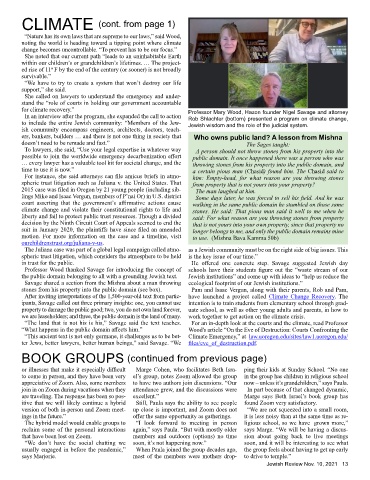
        for climate recovery.”                                 Professor Mary Wood, Hazon founder Nigel Savage and attorney
         In an interview after the program, she expanded the call to action   Rob Shlachter (bottom) presented a program on climate change,
        to include the entire Jewish community: “Members of the Jew-  Jewish wisdom and the role of the judicial system.
        ish community encompass engineers, architects,  doctors, teach-
        ers, bankers, builders … and there is not one thing in society that   Who owns public land? A lesson from Mishna
        doesn’t need to be remade and fast.”                                       The Sages taught:
         To lawyers, she said, “Use your legal expertise in whatever way   A person should not throw stones from his property into the
        possible to join the worldwide emergency decarbonization effort   public domain. It once happened there was a person who was
        … every lawyer has a valuable tool kit for societal change, and the   throwing stones from his property into the public domain, and
        time to use it is now.”                                  a certain pious man (Chasid) found him. The Chasid said to
         For instance, she said attorneys can file amicus briefs in atmo-  him: Empty-head, for what reason are you throwing stones
        spheric trust litigation such as Juliana v. the United States. That   from property that is not yours into your property?
        2015 case was filed in Oregon by 21 young people (including sib-  The man laughed at him.
        lings Miko and Isaac Vergun, members of P’nai Or) in U.S. district   Some days later, he was forced to sell his field. And he was
        court  asserting  that  the  government’s  affirmative  actions  cause   walking in the same public domain he stumbled on those same
        climate change and violate their constitutional rights to life and   stones. He said: That pious man said it well to me when he
        liberty and fail to protect public trust resources. Though a divided   said: For what reason are you throwing stones from property
        decision by the Ninth Circuit Court of Appeals seemed to end the   that is not yours into your own property, since that property no
        suit in January 2020, the plaintiffs have since filed an amended   longer belongs to me, and only the public domain remains mine
        motion. For more information  on the case and a timeline,  visit     to use.  (Mishna Bava Kamma 50b)
        ourchildrenstrust.org/juliana-v-us.
         The Juliana case was part of a global legal campaign called atmo-  as a Jewish community must be on the right side of big issues. This
        spheric trust litigation, which considers the atmosphere to be held  is the key issue of our time.”
        in trust for the public.                                He  offered  one  concrete  step.  Savage  suggested  Jewish  day
         Professor Wood thanked Savage for introducing the concept of  schools  have  their  students  figure  out  the  “waste  stream  of  our
        the public domain belonging to all with a grounding Jewish text.   Jewish institutions” and come up with ideas to “help us reduce the
         Savage shared a section from the Mishna about a man throwing  ecological footprint of our Jewish institutions.”
        stones from his property into the public domain (see box).   Pam and Isaac Vergun, along with their parents, Rob and Pam,
         After inviting interpretations of the 1,500-year-old text from partic-  have launched a project called  Climate  Change Recovery. The
        ipants, Savage called out three primary insights: one, you cannot use  intention is to train students from elementary school through grad-
        property to damage the public good; two, you do not own land forever,  uate school, as well as other young adults and parents, in how to
        we are leaseholders; and three, the public domain is the land of many.  work together to get action on the climate crisis.
         “The land that is not his is his,” Savage said the text teaches.   For an in-depth look at the courts and the climate, read Professor
        “What happens in the public domain affects him.”       Wood's article “On the Eve of Destruction: Courts Confronting the
         “This ancient text is not only germane, it challenges us to be bet-  Climate Emergency,” at  law.uoregon.edu/sites/law1.uoregon.edu/
        ter Jews, better lawyers, better human beings,” said Savage. “We  files/eve_of_destruction.pdf.

        BOOK GROUPS                        (continued from previous page)
        or illnesses that make it especially difficult   Marge Cohen, who facilitates Beth Isra-  ping their kids at Sunday School. “No one
        to come in person, and they have been very  el’s group, notes Zoom allowed the group  in the group has children in religious school
        appreciative of Zoom. Also, some members  to have two authors join discussions. “Our  now – unless it’s grandchildren,” says Paula.
        join in on Zoom during vacations when they  attendance grew, and the discussions were   In part because of that changed dynamic,
        are traveling. The response has been so pos-  excellent.”                 Marge says Beth Israel’s book group has
        itive that we will likely continue a hybrid   Still, Paula says the ability to see people  found Zoom very satisfactory.
        version of both in-person and Zoom meet-  up close is important, and Zoom does not   “We are not squeezed into a small room,
        ings in the future.”                 offer the same opportunity as gatherings.  it is less noisy than at the same time as re-
         The hybrid model would enable groups to   “I  look  forward  to  meeting  in person  ligious school, so we have  grown more,”
        reclaim some of the personal interactions  again,” says Paula. “But with mostly older  says Marge. “We will be having a discus-
        that have been lost on Zoom.         members  and  outdoors  (options)  no  time  sion about going back to live meetings
         “We don’t have the social chatting we  soon, it’s not happening now.”    soon, and it will be interesting to see what
        usually engaged in before the pandemic,”   When Paula joined the group decades ago,  the group feels about having to get up early
        says Marjorie.                       most of the members were mothers drop-  to drive to temple.”
                                                                                            Jewish Review Nov. 10, 2021   13

