


Page 7 - jr111021
P. 7
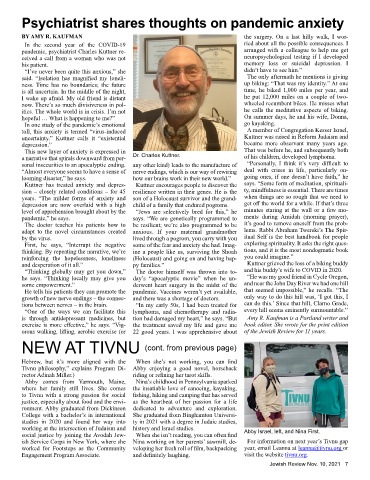
Psychiatrist shares thoughts on pandemic anxiety


        BY AMY R. KAUFMAN                                                         the surgery. On a last hilly walk, I wor-
         In the second year of the COVID-19                                       ried about all the possible consequences. I
        pandemic, psychiatrist Charles Kuttner re-                                arranged with a colleague to help me get
        ceived a call from a woman who was not                                    neuropsychological  testing if I developed
        his patient.                                                              memory  loss or suicidal  depression. I
         “I’ve never been quite this anxious,” she                                didn’t have to see him.”
        said.  “Isolation  has  magnified  my  loneli-                             The only aftermath he mentions is giving
        ness.  Time has no boundaries; the future                                 up biking: “That was my identity.” At one
        is all uncertain. In the middle of the night,                             time,  he biked 1,000 miles  per year, and
        I wake up afraid. My old friend is distant                                he put 12,000 miles  on a couple  of two-
        now. There’s so much divisiveness in pol-                                 wheeled recumbent bikes. He misses what
        itics. The whole world is in crisis. I’m not                              he calls the meditative  aspects of biking.
        hopeful … What is happening to me?”                                       On summer days, he and his wife, Donna,
         In one study of the pandemic’s emotional                                 go kayaking.
        toll, this anxiety is termed “virus-induced                                A member of Congregation Kesser Israel,
        uncertainty.” Kuttner calls it “existential                               Kuttner was raised in Reform Judaism and
        depression.”                                                              became  more  observant  many  years ago.
         This new layer of anxiety is expressed in                                That was before he, and subsequently both
        a narrative that spirals downward from per-  Dr. Charles Kuttner.         of his children, developed lymphoma.
        sonal insecurities to an apocalyptic ending.  any other kind) leads to the manufacture of   “Personally,  I  think  it’s  very  difficult  to
        “Almost everyone seems to have a sense of  nerve endings, which is our way of rewiring   deal  with  crises  in  life,  particularly  on-
        looming disaster,” he says.          how our brains work in their new world.”  going ones, if one doesn’t have faith,” he
         Kuttner has treated anxiety and depres-  Kuttner encourages people to discover the   says. “Some form of meditation, spirituali-
        sion – closely related conditions – for 45  resilience written in their genes. He is the   ty, mindfulness is essential. There are times
        years. “The milder forms of anxiety and  son of a Holocaust survivor and the grand-  when things are so rough that we need to
        depression are  now overlaid  with a  high  child of a family that endured pogroms.   get off the world for a while. If that’s three
        level of apprehension brought about by the   “Jews are selectively  bred for this,” he   minutes  staring  at  the  wall  or  a  few  mo-
        pandemic,” he says.                  says. “We are genetically programmed to   ments during  Amidah (morning prayer),
         The  doctor  teaches  his  patients how to  be resilient; we’re also programmed to be   it’s good to remove oneself from the prob-
        adapt  to  the  novel  circumstances created  anxious. If your maternal  grandmother   lems. Rabbi Abraham Twerski’s The Spir-
        by the virus.                        lived through a pogrom, you carry with you   itual Self is the best handbook for people
         First, he says, “Interrupt  the  negative  some of the fear and anxiety she had. Imag-  exploring spirituality. It asks the right ques-
        thinking. By repeating the narrative, we’re  ine a people like us, surviving the Shoah   tions, and it is the most nondogmatic book
        reinforcing  the  hopelessness, loneliness  (Holocaust) and going on and having hap-  you could imagine.”
        and desperation of it all.”          py families.”                         Kuttner grieved the loss of a biking buddy
         “Thinking globally may get you down,”   The  doctor  himself was thrown into  to-  and his buddy’s wife to COVID in 2020.
        he says. “Thinking locally  may give you  day’s “apocalyptic  movie”  when he un-  “He was my good friend in Cycle Oregon,
        some empowerment.”                   derwent heart surgery in the midst of the   and near the John Day River we had one hill
         He tells his patients they can promote the  pandemic. Vaccines weren’t yet available,   that seemed impossible,” he recalls. “The
        growth of new nerve endings – the connec-  and there was a shortage of doctors.   only way to do this hill was, ‘I got this, I
        tions between nerves – in the brain.   “In my early 50s, I had been treated for   can do this.’ Since that hill, Clarno Grade,
         “One of the ways we can facilitate this  lymphoma, and chemotherapy  and radia-  every hill seems eminently surmountable.”
        is  through  antidepressant  medicines,  but  tion had damaged my heart,” he says. “But   Amy R. Kaufman is a Portland writer and
        exercise is more effective,” he says. “Vig-  the treatment saved my life and gave me  book editor. She wrote for the print edition
        orous walking, lifting, aerobic exercise (or  22 good years. I was apprehensive about  of the Jewish Review for 11 years.
        NEW AT TIVNU                             (cont. from previous page)


        Hebrew, but  it’s more  aligned  with  the   When  she’s  not  working,  you  can  find
        Tivnu philosophy,” explains  Program Di-  Abby enjoying  a good novel,  horseback
        rector Adinah Miller.)               riding or refining her tarot skills.
         Abby comes  from  Yarmouth,  Maine,   Nina’s childhood in Pennsylvania sparked
        where her family still lives. She comes  the insatiable love of canoeing, kayaking,
        to Tivnu  with  a  strong  passion  for social  fishing, hiking and camping that has served
        justice, especially about food and the envi-  as the  heartbeat  of her  passion for a  life
        ronment. Abby graduated from Dickinson  dedicated  to adventure and exploration.
        College with a bachelor’s in international  She graduated from Binghamton Universi-
        studies in 2020 and found her way into  ty in 2021 with a degree in Judaic studies,
        working at the intersection of Judaism and  history and Israel studies.   Abby Israel, left, and Nina First.
        social justice by joining the Avodah Jew-  When she isn’t reading, you can often find
        ish Service Corps in New York, where she  Nina working on her parents’ sawmill, de-  For information on next year’s Tivnu gap
        worked for Footsteps  as the  Community  veloping her fresh roll of film, backpacking  year, email Leanna at leanna@tivnu.org or
        Engagement Program Associate.        and definitely laughing.             visit the website tivnu.org.
                                                                                             Jewish Review Nov. 10, 2021   7

