


Page 44 - Sec02
P. 44
|¬ ~ o
02 2 %$38 &+.5$2
jxj ¥¡p j¥m $- $-
Chemical risks
Bacteriological
&4(#$ 3. &+.5$ 2 %$38 $-
Working with chemicals is very high risk, which means that you need to make sure that you buy the right pair of chemical-resistant gloves.
Chemical-resistant gloves are tested to a standard called EN 374, a standard that informs the wearer about what chemicals the gloves are
designed for use with and for how long. This guide will provide the details of EN 374, helping you to purchase your right pair of Chemical-Resistant Gloves.
! "* 3. ! 2("2 6' 3 (2 $-
EN 374 is a chemical-resistant glove standard that was last modified in 2016. It has wide scope, testing a glove's response to a wide range of chemicals
while taking into account permeability, breakthrough time, shrinkage and more. The standard is divided in five sections which can be viewed below:
· EN 374 - 1: Protective Gloves Against Chemicals and Micro-Organisms
· EN 374 - 2: Determination to Resistance to Penetration
· EN 374 - 3: Determination of Resistance to Permeation by Chemicals (replaced by EN 16523)
· EN 374 - 4: Determination of Resistance to Degradation by Chemicals
· EN 374 - 5: Terminology and Performance Requirements for Micro-Organism Risks
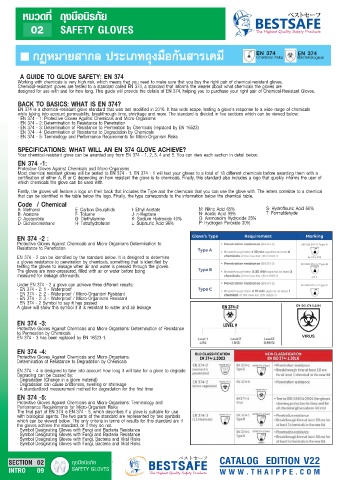
2/$"(%(" 3(.-2 6' 3 6(++ - $- &+.5$ "'($5$
Your chemical-resistant glove can be awarded any from EN 374 - 1, 2, 3, 4 and 5. You can view each section in detail below:
$-
Protective Gloves Against Chemicals and Micro-Organisms
Most chemical resistant gloves will be tested to EN 374 - 1. EN 374 - 1 will test your gloves to a total of 18 different chemicals before awarding them with a
certification of either A, B or C depending on how resistant the glove is to chemicals. Finally, this standard also includes a logo that quickly informs the user of
which chemicals the glove can be used with.
Firstly, the gloves will feature a logo on their back that includes the Type and the chemicals that you can use the glove with. The letters correlate to a chemical
that can be identified in the table below the logo. Finally, the type corresponds to the information below the chemical table.
"NCD "GDLHB@K
A· Methanol E· Carbon Disulphide I· Ethyl Acetate M· Nitric Acid 65% S· Hydroflouric Acid 60%
B· Acetone F· Toluene J· n-Heptane N· Acetic Acid 99% T· Formaldehyde
C· Acetonitrile G· Diethylamine K· Sodium Hydroxide 40% O· Ammonoim Hydroxide 25%
D· Dichloromethane H· Tetrahydrofuran L· Sulphuric Acid 96% P· Hydrogen Peroxide 30%
$-
Protective Gloves Against Chemicals and Micro-Organisms Determination to
Resistance to Penetration
EN 374 - 2 can be identified by the standard below. It is designed to determine
a gloves resistance to penetration by chemicals, something that is identified by
testing the gloves to leakage when air and water is pressed through the gloves.
The gloves are inner-pressured, filled with air or water before being
measured for leakage afterwards.
Under EN 374 - 2 a glove can achieve three different results:
· EN 374 - 2: 1 - Waterproof
· EN 374 - 2: 2 - Waterproof / Micro-Organism Resistant
· EN 374 - 2: 3 - Waterproof / Micro-Organisms Resistant
· EN 374 - 2 Symbol to say it has passed
A glove will show this symbol if it is resistant to water and air leakage EN ISO 374-5:2016
$-
Protective Gloves Against Chemicals and Micro-Organisms: Determination of Resistance
to Permeation by Chemicals ,
EN 374 - 3 has been replaced by EN 16523-1. VIRUS
$-
Protective Gloves Against Chemicals and Micro-Organisms:
Determination of Resistance to Degradation by Chemicals
EN 374 - 4 is designed to take into account how long it will take for a glove to degrade.
Degrading can be caused by:
· Degradation (Change in a glove material)
· Degradation can cause brittleness, swelling or shrinkage
· A standardized measurement method for degradation for the first time
$-
Protective Gloves Against Chemicals and Micro-Organisms: Terminology and
Performance Requirements for Micro-Organism Risks
The final part of EN 374 is EN 374 - 5, which describes if a glove is suitable for use
with biological agents. The two parts of the standard are represented by two symbols
which can be viewed below. The only criteria in terms of results for this standard are if
the gloves achieve the standard, or if they do not.
· Symbol Designating Gloves with Fungi and Bacteria Resistance
· Symbol Designating Gloves with Fungi and Bacteria Resistance
· Symbol Designating Gloves with Fungi, Bacteria and Viral Risks
· Symbol Designating Gloves with Fungi, Bacteria and Viral Risks
CATALOG EDITION V22
ϕετηʔϑ
2$"3(.- 02 ¡p Ê| j¡Õ qj} BESTSAFE
/(8 , -$$ &1.4/ ". +3#
(-31. 09 2 %$38 &+.5$2
¢Ô¥kÔ
¢Ô
~ ¦q}qÓmÔ¥¡j|×¥t~®¦mpq 2 %$38 3$"'-.+.&8 6(3' 8.4 BEST SAFE (THAILAND) CO.,LTD
WWW.THAIPPE.COM
666 3' (//$ "., [ 666 -42.1-!$232 %$ "., 666 /(8 , -$$ "., [ 666 /(8 , -$$&1.4/ "., 666 !$232 %$ ". 3' [ 666 !$232 %$/1.#4"32 ".,

