


Page 32 - Sec02B
P. 32
หมวดที่ ถุงมือนิรภัย ESTSAFE ®
02 SAFETY GLOVES BESTSAFE GLOVE CO.,LTD
THOERY OF GLOVE & TESTING METHOD BESTSAFE GLOVE CO.,LTD
แหลงที่มาของขอมูล : ref : ศูนยวิเคราะหทดสอบสิ่งทอ สถาบันพัฒนาอุตสาหกรรมสิ่งทอ
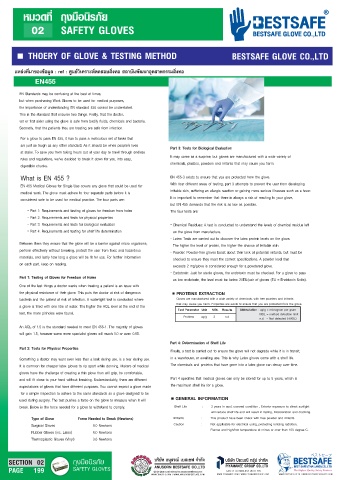
EN455
EN Standards may be confusing at the best of times,
but when purchasing Work Gloves to be used for medical purposes,
the importance of understanding EN standard 455 cannot be understated.
This is the standard that ensures two things. Firstly, that the doctor,
vet or first aider using the glove is safe from bodily fluids, chemicals and bacteria.
Secondly, that the patients they are treating are safe from infection.
For a glove to pass EN 455, it has to pass a meticulous set of tasks that
are just as tough as any other standard. As it should be when people’s lives Part 3: Tests for Biological Evaluation
at stake. To save you from taking hours out of your day to trawl through endless
rules and regulations, we’ve decided to break it down for you, into easy, It may come as a surprise, but gloves are manufactured with a wide variety of
digestible chunks. chemicals, plastics, powders and irritants that may cause you harm.
What is EN 455 ? EN 455-3 exists to ensure that you are protected from the glove.
EN 455 Medical Gloves for Single Use covers any glove that could be used for With four different areas of testing, part 3 attempts to prevent the user from developing
medical work. The glove must adhere to four separate parts before it is irritable skin, suffering an allergic reaction or gaining more serious illnesses such as a fever.
considered safe to be used for medical practice. The four parts are: It is important to remember that there is always a risk of reacting to your glove,
but EN 455 demands that the risk is as low as possible.
- Part 1: Requirements and testing of gloves for freedom from holes The four tests are:
- Part 2: Requirements and tests for physical properties
- Part 3: Requirements and tests for biological evaluation - Chemical Residues: A test is conducted to understand the levels of chemical residue left
- Part 4: Requirements and testing for shelf life determination on the glove from manufacture.
- Latex: Tests are carried out to discover the latex protein levels on the glove.
Between them they ensure that the glove will be a barrier against micro-organisms, - The higher the level of protein, the higher the chance of irritable skin.
perform effectively without breaking, protect the user from toxic and hazardous - Powder: Powder-free gloves boast about their lack of potential irritants, but must be
materials, and lastly how long a glove will be fit for use. For further information checked to ensure they meet the correct specifications. A powder level that
on each part, keep on reading. exceeds 2 mg/glove is considered enough for a powdered glove.
- Endotoxin: Just for sterile gloves, the endotoxin must be checked. For a glove to pass
Part 1: Testing of Gloves for Freedom of Holes as low endotoxin, the level must be below 20EU/pair of gloves (EU = Endotoxin Units).
One of the last things a doctor wants when treating a patient is an issue with
the physical resistance of their glove. This puts the doctor at risk of dangerous PROTEINS EXTRACTION
bacteria and the patient at risk of infection. A watertight test is conducted where Gloves are manufactured with a wide variety of chemicals, with free powders and irritants
a glove is filled with one litre of water. The higher the AQL level at the end of the that may cause you harm. Properties are exists to ensure that you are protected from the glove.
test, the more pinholes were found. Test Parameter Unit MDL Results Abbreviation : ug/g = microgram per gram
MDL = method detection limit
Protiens ug/g 3 n.d n.d. = Not detected (<MDL)
An AQL of 1.5 is the standard needed to meet EN 455-1. The majority of gloves
will gain 1.5, however some more specialist gloves will reach 1.0 or even 0.65.
Part 4: Determination of Shelf Life
Part 2: Tests for Physical Properties
Finally, a test is carried out to ensure the glove will not degrade while it is in transit,
Something a doctor may want even less than a leak during use, is a tear during use. in a warehouse, or awaiting use. This is why Latex gloves come with a shelf life.
It is common for cheaper latex gloves to rip apart while donning. Makers of medical The chemicals and proteins that have gone into a latex glove can decay over time.
gloves have the challenge of creating a thin glove than will grip, be comfortable,
and will fit close to your hand without breaking. Understandably, there are different Part 4 specifies that medical gloves can only be stored for up to 5 years, which is
expectations of gloves that have different purposes. You cannot expect a glove made the maximum shelf life for a glove.
for a simple inspection to adhere to the same standards as a glove designed to be
used during surgery. The test pushes a force on the glove to measure when it will GENERAL INFORMATION
break. Below is the force needed for a glove to withstand to comply. Shelf Life : 3 years in cool, covered condition , Exterior exposure to direct sunlight
will reduce shelf life and will result in fading, Discoloration and cracking.
Type of Glove Force Needed to Break (Newtons) Irritants : This product have been check with free powder and irritants.
Surgical Gloves 9.0 Newtons Caution : Not applicable for electrical using, protecting ionizing radiation,
Rubber Gloves (inc. Latex) 6.0 Newtons Flames and high/low temperature at minus or over than 100 degree C.
Thermoplastic Gloves (Vinyl) 3.6 Newtons
ϕετηʔϑ
SECTION 02 ถุงมือนิรภัย บริษัท ปยะมณี กรุป จำกัด BESTSAFE
PIYAMANEE GROUP CO.,LTD
PAGE 199 SAFETY GLOVES ผูนำเขา ผูผลิต และจัดจำหนายสินคาประเภทอุปกรณเซฟตี้แบบครบวงจร SAFETY TECHNOLOGY WITH YOU BEST SAFE (THAILAND) CO.,LTD
WWW.THAIPPE.COM | WWW.ANUSORNBESTSAFE.COM WWW.PIYAMANEE.COM | WWW.PIYAMANEEGROUP.COM WWW.BESTSAFE.CO.TH | WWW.BESTSAFEPRODUCTS.COM

