


Page 147 - English Lesson Plan Year 3
P. 147
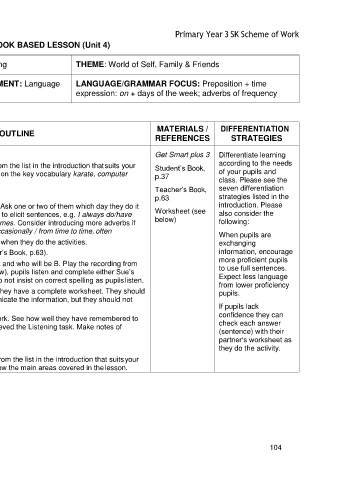
Primary Year 3 SK Scheme of Work
 SCHEME OF WORK: TEXTBOOK BASED LESSON (Unit 4)

 LESSON: 54 (Listening 11)   MAIN SKILL FOCUS: Listening   THEME: World of Self, Family & Friends
 WEEK:   TOPIC: Year in, year out   CROSS-CURRICULAR ELEMENT: Language   LANGUAGE/GRAMMAR FOCUS: Preposition + time

                    expression: on + days of the week; adverbs of frequency


 CONTENT   LEARNING                     MATERIALS /     DIFFERENTIATION
 STANDARD   STANDARD   LEARNING OUTLINE   REFERENCES      STRATEGIES

 Main Skill   Main Skill   Pre-lesson   Get Smart plus 3   Differentiate learning
 Listening 1.2   Listening 1.2.2   1.  Choose an appropriate pre-lesson activity from the list in the introduction that suits your   Student’s Book,   according to the needs
 Understand   Understand with   pupils’ needs and interests and that focuses on the key vocabulary karate, computer   p.37   of your pupils and
 meaning in a   support specific   games, tennis, cinema.   class. Please see the
 variety of familiar   information and   Lesson delivery   Teacher’s Book,   seven differentiation
 contexts   details of short            p.63           strategies listed in the
    simple texts   2.  Ask pupils if they often do the four activities. Ask one or two of them which day they do it   Worksheet (see   introduction. Please
       on, remind them of the adverbs of frequency to elicit sentences, e.g. I always do/have   below)   also consider the
 Complementary   Complementary   karate on Monday; I never play computer games. Consider introducing more adverbs if   following:
 Skill   Skill   appropriate/necessary for your class, e.g. occasionally / from time to time, often   When pupils are
 Speaking 2.1   Speaking 2.1.2   3.  Ask pupils to tell their partner how often and when they do the activities.   exchanging
 Communicate   Find out  about   4.  Follow the instructions for Activity 3 (Teacher’s Book, p.63).   information, encourage
 simple information   and describe basic               more proficient pupils
 intelligibly   everyday routines   5.  Put pupils in pairs; they decide who will be A and who will be B. Play the recording from   to use full sentences.
 Activity 3 again. On the worksheet (see below), pupils listen and complete either Sue’s
 Diary (Pupils A) or Bob’s Diary (Pupils B). Do not insist on correct spelling as pupils listen.   Expect less language
                                                       from lower proficiency
 6.  Pupils exchange the information in pairs so they have a complete worksheet. They should   pupils.
 do this by speaking to each other to communicate the information, but they should not
 look at each other’s worksheets.                      If pupils lack
                                                       confidence they can
 7.  Collect the worksheets and review pupils’ work. See how well they have remembered to   check each answer
 spell the words and how well they have achieved the Listening task. Make notes of
 common mistakes and of pupils’ progress.              (sentence) with their
                                                       partner‘s worksheet as
 Post-lesson                                           they do the activity.
 8.  Choose an appropriate post-lesson activity from the list in the introduction that suits your
 pupils’ needs and interests and that will review the main areas covered in the lesson.


                                                                    104

